25 March 2013

Affection


Do you know that Manila is also called the ‘City of Our Affections’? It is. The nickname has quite a nice ring to it—it sounds, to me, a bit more thoughtful than the romantic ‘Pearl of the Orient’—but don’t, I advise, mistake “nice” and “thoughtful” for “feel-good.” To me, the nickname has always been injected with a certain pathos.

To questions of why, I’ll defer to a key part of “If These Walls Could Talk,” Carlos Celdran’s famous Intramuros tour, in which tour-goers are led into one of the historical district’s old American barracks in Fort Santiago. It’s the part that involves a pull-down projection screen and a slideshow featuring MacArthur and his Ray-Bans (in grainy sepia), a group of soldiers carrying the Japanese flag, and a black-and-white close-up of a bomb that half-eclipsed an aerial view of the city on which it was about to drop. The city in the photo—the city in which all the photos were taken—is Manila. You’re supposed to sit solemnly in a pew during this part, such that it seems wholly appropriate to call to mind the phrase, all together now, ‘City of Our Affections’—never mind if it must have caught on long before the war. Say it under your breath, and it takes on a strange, quiet wretchedness akin to that of a prayer being uttered at a funeral. A funeral for 100,000.

I do wonder sometimes: can these affections be evoked, be revived, without the help of a performance? Also: Manila is the city of whose affections, exactly? I don’t mean to be disagreeable. But last week, walking along Padre Burgos Street, I saw a homeless man just outside the gated golf course in Intramuros. He was peeing on the grass through a wire fence. (The newspaper men at the Manila Bulletin building in front could see his equipment, surely.) A few feet away, meanwhile, also on the sidewalk, was a young boy sleeping on a bed of rice sacks. Next to him a sign read, “Watch out! Flying golf balls.” His mother must have been the woman who was washing her clothes in the pool of water surrounding a monument: the Gomburza monument, I think it was. Why she chose to do her laundry there, I can’t tell you. The water was not clean, and on it sailed fallen leaves. 

To be sure, Manila is not the city of these people’s affections. Turning the golf course into a urinal, sleeping on concrete, washing dirty linen in spaces reserved for marble heroes: like they would ever give a damn what the place is called. But it is because of them, hollow and sentimental as this sounds, that Manila might become the city of someone’s affections: mine. Not that I wish to take any credit for grand gestures of kindness subsequently performed—if you really want to know, I was only making my way to Muralla Street for dinner; affection could do with, but does not require, kind gestures. (As tourists often say, “You cannot save everybody.”) In any event: are these people not collateral damage, too? From a different war with a different name. I’ll let you call it whatever you like. What I’ll say is that if hearts grow fonder upon engagement in the remembrance of history, so must mine—if not every Manileño’s—on a walk today through the old city streets.

Which raises the question: why is the golf course still there?

Out of the Game


I must be getting old. (Which is okay, by the way.) Recently, encouraged by Roger Rosenblatt’s New York Times piece on the best movies about a writer, I watched the film adaptation of Starting Out in the Evening, which is based on a novel by Brian Morton. To my horror, then not so much, I found that I could see myself more in the old, writerly Leonard Schiller character (played by Frank Langella) than in the young, student-y, brimming-with-enthusiasm Heather Wolfe (played by fire-haired Lauren Ambrose). Not because Schiller is a writer, which I claim to be (besides, so is Wolfe—she’s writing her thesis), but because Schiller is old—older—and would rather not suffer from the intense but short attentions of young people. 

This is not to say that I regularly attract young—younger—people’s attention. I don’t. Of the intense kind, I attract even less. I only mean that if I do, I won’t be able to keep up with it. I know so! As Rufus sings, not too sadly, “I’m out of the game.” And the game, whatever it was, was invariably something I’d be useless at playing in the first place. 

If this sounds outlandish and awfully ageist, forgive me. But it’s true. A few days ago in a bar I met a pair of backpackers barely out of their teens and, next to them, I could positively hear my bones creaking. One was from France, the other from Denmark, and they began to talk to me about beer—the beers of the world. It was a conversation that lasted close to three hours, felt longer (much!), and involved voluntarily dished out lists of breweries visited, places sojourned in, cultures absorbed, exotic foods sampled, sexual encounters had, wealth squandered and wealth accumulated; it was, in short, the kind of conversation that was not about beer, really. It was about being young, wild, and free (or Eat, Pray, Love as told by two guys in a room). I made less than a little contribution to it. Here’s an old-person skill I did not use to have: I managed to talk without actually saying anything.

Now if only I can find people who’ll tell me something about books instead of beer. Or about Starting Out in the Evening. About anything! As long as it brings to the surface how one thinks instead of what one thinks. Also: age doesn’t matter, as long as it doesn’t get in the way. I thought I’d find friends in bars. Obviously not! But I’m only half-kidding, which goes to show that I don’t know as much as I think I do—a fact that to me will be clearer in a few years, and much, much clearer in a lot of years.

07 March 2013

We Must Not Touch Our Idols


We must not touch our idols; the gilt sticks to our fingers.

I just finished reading Madame Bovary. (Phew!) It took a long time. It took three sleepless nights to get through the last part. By the end of the third night, I was crying. Flaubert had me. For whom were these tears, you might ask? For Charles Bovary, Emma’s husband. 

So what if Charles is common, unsophisticated, not intellectual? He is a good man. He is kind, hardworking, loyal. That’s the most important thing, isn’t it? That’s all one can ask for from a man—from a spouse. Few deserve Charles. Emma doesn’t. I certainly don’t. (Not that it’s a matter of what one deserves.) But it’s funny because I wrote recently to a friend about how I could identify with Emma, who is irresponsible and a total romantic, who lapses into boredom, sickness, and depression whenever reality fails to match her ideas. (It’s awful, but that’s me. I touch idols until inevitably they cease to be idols.) And yet in the end it was Charles for whom I was suddenly rooting. It was for him that I was suddenly feeling.

One of the most interesting things about the creation of Madame Bovary is that the first English translation of it—that which I read—was produced by Eleanor Marx, the youngest daughter of Karl Marx. If you’ve read the novel, the story of Eleanor’s death will sound horribly familiar. She was sickened by, among other things, a love affair: this was with socialist campaigner Edward Aveling. So sickened was she that she decided to send her maid Gertrude to the chemist for chloroform and hydrogen cyanide. Eleanor swallowed the poison in the privacy of her room. Unlike Emma, however, she actually had time to pen a final billet-doux. “Dear, it will soon be all over now,” she wrote in her suicide note to Edward. “My last word to you is the same that I have said during all these long, sad years: love.”

25 February 2013

Bereft


It was with shock that I read about the recent death of a schoolmate—the sudden death, only a few days ago, of a man whom I had not seen since our high school graduation in 2001. According to the news report, he was killed when the wayward jeepney in which he was riding tipped over and fell on its side—his side. He was twenty-nine.

We weren’t friends exactly; I can’t recall him ever speaking to me, or me to him, although we must have spoken to each other at one point or another. We did go to school together, starting from kindergarten at the old Little Angels in Quezon City, where we, I remember, were classmates. So in a way his face was a fixture in the scenes of my childhood. We grew up together, in a way. This must explain part of the shock: he could have been a friend of old. That he wasn’t—that I knew him only through other friends, from a place and time I don’t terribly miss—does not make his death any less shocking. It doesn’t make me feel less sad. Anyone his age is too young to die.

I do wonder if such terrible news could be made less terrible if one didn’t find out about it through Facebook. I was, in fact, Facebook friends with the deceased. We had over a hundred mutual friends. I’d gotten so used to seeing or hearing about others’ birthdays, romances, breakups, engagements, weddings, babies, promotions, habits, diets, travels, pleasures, parties, possessions—their proofs of life—that the announcement of someone’s death, a proof of the end of someone’s life, came as something entirely unexpected. When the “Rest in peace” posts began to appear on my News Feed—posts written by fellow schoolmates—my heart jumped. Then I felt embarrassed. I realized with sudden horror that Facebook was a massive cocktail party and I had just followed a crowd into a private room with a casket in the middle. Is there a clumsier way of having this sort of news broken? I think not. You could be holding a martini in your hand while everyone else is consoling the bereaved. 

23 February 2013

Thanking Daniel


Note: This piece was originally published December 2012 in Positively Filipino, a new online magazine celebrating the story of the global Filipino. The magazine title is taken from an infamous sign posted on the front door of a Stockton, California hotel in the 1930s. The sign read, “Positively No Filipinos Allowed.”

A couple of weeks ago, I met for the first time the editorial group, led by founder and former Filipinas Magazine publisher Mona Lisa Yuchengco and managing editor Gemma Nemenzo. My fellow contributors are a lovely bunch; I encourage you to visit the site and read their pieces.

A few days ago I was out late with my friend E at Barrio Lastarria. It must have been around three or four in the morning and we were already—or only, given the place and time—half-drunk.

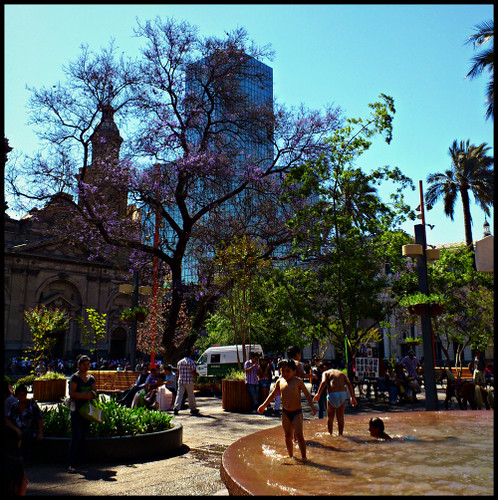
“Maybe El Toro will still be open,” E suggested, since around us the pubs and cafés were either closed or closing. So we walked north toward Parque Forestal, an eerily beautiful park created on reclaimed land from the Mapocho River, on our way to Loreto Street in Bellavista, the sleepless bohemian barrio of Santiago, Chile.

At the park we noticed a group of four young men in hoodies who had emerged from leafy shadows and appeared to be following us. One of them carried a bat of some sort: the baseball or cricket sort. A few seconds later, a fifth man—slightly older, but no more than thirty, with a shaved head—also seemed to come from nowhere and began to walk even more hurriedly in our direction.

“Jacket, please,” E began to say, in a tone that verged on being hysterical. “Your jacket! Put it on.” A clueless, silly foreigner, I did what he asked me to do while the fifth man caught up with us. He approached with a kind of swagger, with a cocky little smile that to me looked less amiable than threatening. Addressing E, he inquired, “¿Qué hora es?”—as if there were a train to catch, an appointment to make, or a deadline to beat; as though it was the most common thing in the world to be asking for the time in the dead of the night-morning while the rest of the city slept or got lost in the heady blur of cervezas and vinos

It was only after E gave the time and, without warning, plucked my sleeve and we burst out running, as fast and as far out of the park as we could, without looking back, without bothering to check where and who the chasers were, if indeed they chased and not simply stood there laughing at us—it was only after this sudden, harrowing half-minute that E told me we had just escaped neo-Nazis.

At the mention of this I positively shivered. Neo-Nazis in Chile are known to discriminate against a wide range of minorities, including homosexuals, Peruvian immigrants, punk rockers, alcoholics, drug addicts, even whites from southern Europe. About Asians I don’t know how they feel exactly, but I won’t hesitate to say that the scare at the park could have turned into something perilously worse. Last March, neo-Nazis killed a twenty-four-year-old Chilean gay man named Daniel Zamudio. They attacked him in Parque San Borja, which is also along Alameda, five minutes away from Parque Forestal. There were four attackers; according to reports, they beat Daniel up for an hour, broke both his legs, cut off one of his ears, seared his skin with cigarettes, pounded his head with a stone, and carved swastikas on his abdomen using the neck of a broken bottle of pisco sour. He died a couple of weeks later in the hospital.

“I’m sorry we had to go through that,” said E, who is gay. The apology was not necessary. What was he saying sorry for? I was alive and unharmed. Though jolted sober with hearts still pounding, we were alive. As though to relish this fact, we sat on a sidewalk on Dardignac Street in Bellavista and simply stayed there for at least two hours, only getting up just before the sun rose.

A sidewalk: when I came eleven thousand miles from Manila to work in Santiago, I well expected to feel transplanted—to spend my days in a state of perplexity and unbelonging. I expected correctly. Save for a graphic designer who recently left for Nagpur in India, I have not met another Filipino. There is, in fact, nothing here that can be described as being from home or of home: there isn’t a single Filipino restaurant, a single Filipino club, a single Filipino anything. More than once I have wondered if, as a temporary resident of Chile, I may as well be living in another planet. 

Like E, I also happen to be gay. This makes it almost impossible for me to be any more a ‘minor’ than I already am (unless I tried to like punk rock, which I believe I am too old for), and indeed if there was a place in Santiago where I belonged, at least as much as E did, it certainly would not be Parque Forestal, among Chilean neo-Nazis roaming, waiting, moving to pounce.

Yet—yet—as we sat later on concrete in the wee hours of the morning, I began to wonder if there was a more profound way of gaining and strengthening one’s sense of identity than to encounter people bent on disagreeing with it; if, in the face of fear, or amid threats of intolerance, hatred, and discrimination, one might suddenly become more honest and frank about himself. “You don’t look Chilean,” E said when I asked, half-jokingly, if I could pass for one. Of course not—and I always knew it. But never have I felt more exceptionally Filipino than here on the streets of Santiago, under the glare of people who are shockingly non-Asian, and never has the fact of my sexuality asserted itself more swiftly than when I was made to grasp, both by telling and by reimagining, the heartbreaking tragedy that befell Daniel Zamudio. 

E told me that he was one of thousands who lit candles the day Daniel died. Shortly after that Chilean President Sebastian Piñera accelerated the passage of an anti-discrimination law designed to prevent hate crimes and violations of fundamental human rights. I was still in Manila then, occupied by the comforts and entanglements of the Filipino commonplace. But if somehow there was a way to reach out to the dead, to the murdered, I’d say to Daniel, thank you for your life. My journey across thousands of miles no longer seems so distant, and I can be more fearless roaming the world you had left.

29 January 2013

Fondly, Niña


Again her left eye is swollen shut and again I know it must be to do with some unknown girlfriend or lover. She’s at the kitchen cooking chicken adobo, which she’ll pack neatly in Tupperware and eat later during a break from her usual night shift at the call center. Hi Miguel, she says, so I say hi back. Hi Ate Niña. 

The pair of sunglasses that she was wearing when she came in is on the dinner table. Her backpack, whatever is in it, wherever it has been, is propped on one of the chairs. I am sitting quietly at the table in front of my laptop and again I am filled with rage. Who is this person beating up my sister? Who is abusing her love? Because Lourdes—fondly, Niña—is loving—sometimes to a fault. It’s one of the things I have learned, that it’s possible to be loving to a fault. Another thing I have learned is that sometimes it’s better to be discreet and not say anything, even when there’s an elephant in the room.

So I don’t say anything. I simply let her watch a YouTube video on my computer, the audition of a stuttering gay Cuban singer on American Idol, and while she’s sitting next to me I do my best to ignore the plastic spatula in her hand dripping soy sauce on the floor. 

The eye is black just above the lid. It’s so swollen it looks like a nasty cockroach bite. The fact that it’s so dark, that it’s so black, makes me cringe. There have been times when it’s not the eye, when the bruises are on the cheeks, or the legs, or the shoulder muscles, or somewhere under the rib area, just under her breasts. There have also been times when the eyes are swollen but only from crying. You hear bits of her talking on the phone throughout the night—her sniffs and wails. Then she comes out of her bedroom in the morning and you know that something’s up. You smell her suffering. 

Once when we were children Niña couldn’t remove herself from the hollow newel at the top of our ancestral house’s green spiral staircase. We had been playing hide-and-seek and she had covered herself with a bath towel so that I wouldn’t be able to find her. But I did, easily. The edge of the sleeve of her fuchsia San Miguel Pale Pilsen t-shirt was showing—not to mention the bump under the towel that was obviously her head. Huli ka! I said. But no matter how effortlessly she had inserted herself in that gap, getting herself out seemed somehow impossible. Father had to come up and assist, and it put an end to the game. Niña was in tears.

Well, she’s thirty-five now, a beautiful grown woman. Time does fly fast, especially if you count not by years but by tragedies. The face of the lover-enemy who does this to her, I have not seen, and the violent parts of her life that leave marks on her body, I cannot claim to know, but the blood that runs through her veins remains ever the same as mine. To see her in such a state—to be helpless about it—it jolts the heart and cramps the fist.

Finally the chicken is done. She turns off the kitchen stove and we watch another audition, this time of a transgender contestant with a guitar who claims she’s from “North Carolina, Planet Earth.” This part makes us laugh. Niña, watching closely, says, I can’t figure out if he used to be a girl or she used to be a guy. Clearly she used to be a guy, I say. Then the contestant begins to sing, and her voice turns out to be like honey. 

You might find me by the side of the road, in that old train yard;
You might find me on the corner, with a smile on my face, strumming on my guitar.
I’m out here wandering underneath an azure sky;
I’m gonna keep on wandering ‘til my days on God’s green earth are done.

20 January 2013

Joel


He was sitting with a little girl at a table next to mine inside Chowking. He wore a crumpled army cap, a provincially (as opposed to metrosexually) tight grey t-shirt, a pair of ripped jeans. I assumed that he, too, was waiting for the orange chicken lauriat. The day had slowed down in the hours after lunch and so, it seemed, had the service. But when finally my food came his didn’t. He hadn’t ordered anything.

His name is Joel. He is from Lucena, Quezon, a provincial city southeast of Manila and north of Tayabas Bay. Early in the morning he, along with the little girl, his daughter, took a Philippine Rabbit bus to see the big city and visit the Children’s Museum. On their way to the museum Joel realized that his wallet was missing. It had been stolen. By whom he did not know; he did not even feel anything when it happened. He was thus left with no cash. The two hundred dollars that he, a repatriate, had brought for exchange were gone, too. He had to call the bank to cancel his credit card. But how was he going to make his way back home? The bus conductors refused to give him a ticket in exchange for a promise. The cops to whom he reported the theft could not do anything apart from write an entry on the blotter, because what more could be done? This is life. People’s wallets get stolen all the time—especially in this part of the city, on these streets, which can be dangerous, harsh, and unkind, preying on those who look clueless, who do not look and act and sound like Manileños. 

I am a Manileño. When Joel told me his story it was not my first time hearing of such a thing. I had never fallen for it. There are different versions. Sometimes it’s a mother who has to pay a deposit to the Philippine General Hospital so that her sick son or daughter can be admitted. Sometimes it’s a public school student at the bus station who has simply run out of money for the fare. Sometimes it’s an impossibly attractive young woman who is supposed to have fled her abusive husband. (She isn’t fooling me.) The story invariably closes with a plea for help, then with me turning deaf and walking away.

Joel’s daughter has asthma. While her father and I talked she slept with her head rested on the table, next to his yellow-cased iPhone, her shiny Captain America action figure, and the pink, patterned JanSport backpack that contained her nebulizer. I’m guessing she’s about eight or nine. She had been looking forward to visiting the museum, he said, but now, after some hours of despair, neither of them had the energy to even do anything, apart of course from wait for the in-laws in Lucena to call and confirm if anyone was coming to pick them up.

A part of me believed nothing that Joel said. It’s the part called common sense. But another part reached for my wallet and gave the money that common sense was too pained to give, and which Joel had not asked for. I hope this helps, I said, handing the peso bills out discreetly, under the table. It felt odd to do that; it felt almost illegal—a crime against reason. What was I thinking? Joel thanked me profusely—he was actually teary-eyed—while quietly I wrestled with the terrible thought that I may have been conned. 

But if I have been conned, so what? Isn’t it more okay, isn’t it healthier, to let your guard down at least once than to never let it down at all, ever? To know you have a heart, however foolish; to feel you’re alive; to learn in very sudden fashion that you can get struck no matter how thick and high the walls you have built to protect against it. Essentially, to be reset to default; to be unclouded by adult doubts and suspicions. Others can laugh. But the cost of a bus ticket to Lucena is a price I’m willing to pay for a temporary yet necessary disengagement from cynicism, from a deep Manileñan distrust of city men and women. When I got up to leave the restaurant, Joel told me that I was a decent man, and whether he was putting me on or not I took it that he meant ‘decent’ and not ‘stupid’. Let father and daughter make their way home.

Related: “Thieves in Our City

11 January 2013

Drag


Last time I saw you
We had just split in two.
You were looking at me.
I was looking at you.
You had a way so familiar,
But I could not recognize,
‘Cause you had blood on your face;
I had blood in my eyes.
But I could swear by your expression
That the pain down in your soul
Was the same as the one down in mine.
That’s the pain,
(That) cuts a straight line
Down through the heart;
We call it love.

— From “The Origin of Love”

Ever heard of To Wong Foo, Thanks for Everything! Julie Newmar? It’s a movie that I watched when I was a young boy. HBO had shown it a bunch of times, sometimes twice in one day. So I watched it a bunch of times, too. (In those days—we’re talking mid to late nineties here—I preferred to stay awake while everyone took their siestas.) Back then, I, being no more than twelve or thirteen, didn’t really understand what the movie was about. It was lost on me. (As was everything else possibly important in my misspent youth.) But I do remember how I felt seeing Wesley Snipes, Patrick Swayze, and John Leguizamo in drag. I felt startled. Men dressed up as women! My Christian Living teachers would not have approved of it.

I was also held spellbound. 

I bring up To Wong Foo because recently—between hours of listening to Georgette Dee and Frank Ocean—I watched The Adventures of Priscilla, Queen of the Desert and Hedwig and the Angry Inch. Both of these are—how do you describe it?—both are drag queen movies. They kind of brought back the same feelings that I had had watching To Wong Foo as a kid. Hugo Weaving, Terence Stamp, and Guy Pearce were freaking fabulous in the former; and if I start with John Cameron Mitchell in the latter, I will not run out of good things to say. He was simply terrific as the title character, a transsexual singer from Berlin supposed to represent, metaphorically speaking, the old divide between communist East Germany and democratic West Germany. The story is more philosophical than political, though. If you haven’t seen Hedwig and the Angry Inch—well, I would at least recommend that you look for and listen to “The Origin of Love,” one of the songs from the original stage show (the film is an adaptation of a musical by Stephen Trask), which is based on Aristophanes’ speech in Plato’s Symposium. The sound, I daresay, is Bowie-esque. The lyrics are even nicer.

Are all drag queen movies supposed to be preposterous? I won’t pretend to have an opinion on the matter. (People who know me, however, will hasten to tell you that I can be either a drag or a queen!) Besides, if they are, it’s probably because they’re only being faithful to the dramas and realities of drag queenship. A couple of months ago, I was hanging out with my dear friend M at a local bar on Pio Nono in Santiago, Chile, and we came across this dancing man-woman who touched, or attempted to touch, the ass of every male passerby. It was a hoot. Escudo almost came out of my nostrils, and M and I had as good a time as she did. She was dancing, shaking, sashaying in this glittered lavender ensemble, complete with bold red lipstick, a classic blonde wig, and heels that clattered, and she reminded me, not with words but with appearance and action, that I took life way too seriously, that I ought to have fun once in a while, you know? The way she was having fun. Someone gave her a quiniento—an insult to her talent, apparently—and she just tossed it in the air and proceeded to grab the shirt of a random Chileno for a few minutes of non-traditional street-side cueca. Again I was held spellbound, but no longer was I startled. 

29 December 2012

Solitude


...love your solitude and bear with sweet-sounding lamentation the suffering it causes you. For those who are near you are far, you say, and that shows it is beginning to grow wide about you. And when what is near you is far, then your distance is already among the stars....
...your solitude will be a hold and home for you even amid very unfamiliar conditions and from there you will find all your ways. 

While living and working in Chile, I picked up a habit of reading several books at the same time. It was not something I was used to doing, so more than one book was one or more books too many, especially given my extremely short attention span. I can’t say that I accomplished anything by doing this; even worse, I can’t figure out why I did it in the first place. But I started with Edward St Aubyn’s series of Patrick Melrose novels, and it took forever to get to At Last. That’s because I was also reading Howards End and Bouvard et Pécuchet on my phone, and a random selection of essays by Cynthia Ozick on my computer, and The House of the Dead (a tattered copy of which I bought from Libros El Cid Campeador on Merced Street), and stories from Colm Tóibín’s Mothers and Sons collection, and, later on, after mi jefe C had given me a Kindle, Justin Halpern’s Sh*t My Dad Says. (Guess which one entertained the most.)

For my return flight to Manila I thus resolved to stick to one book, Rainer Maria Rilke’s Letters to a Young Poet, from which the above passage comes. I like writing letters, and I love reading them even more. About four years ago I read the 700-plus-page Decca: The Letters of Jessica Mitford, which proved to be at once a hoot and treasure, and instantly made me want to be a more outstanding correspondent; the book was given to me by a friend in New York. The Rilke, meanwhile, was given by another friend, who told me about another passage (from the same collection of letters) that I agreed was pretty useful advice for writers. (Identification of this other passage upon request.) He added a Flavia Weedn quote as his dedication, and it is the exact same quote that was printed on a bedroom poster (of a bear) that I had when I was a kid. (Identification of quote also upon request.)

So anyway: I read the Rilke in the time that it took to get from Santiago to Manila. My stops were São Paulo, Dubai, and Kuala Lumpur. After several months in Chile of not hearing another human being speak Tagalog, I was relieved to hear and see Filipinos at the Dubai International Airport. But I never did move to speak to them. The book absorbed me completely, and even though I had not given Rilke’s poems a try, I was glad to have his letters, which made the forty-hour journey somehow shorter.

23 December 2012

Julia Roberts


My friend J got married today. She looked so beautiful. The wedding was held just outside of Manila, at San Antonio de Padua in Silang, Cavite, followed by the reception at Hacienda Isabella, a charming private resort neatly tucked somewhere at the foot of the Tagaytay mountain ridge. I sat with a group of friends from the university and before the night ended, J came over to our table and showed us her ring. She also told us the story of how her husband had proposed—which he did, if I heard correctly (and if I didn’t, blame the vodka), after a hike somewhere in Malaysia, on top of another mountain called Gunung Datuk. 

J’s wedding is only the latest in a series of wedding- or engagement-related notifications I have recently received on Facebook. I don’t know how or why exactly these notifications have suddenly come to multiply—is twenty-eight or twenty-nine the new twenty-five, or are couples simply keen to avoid the curse of 2013?—but at least seven other friends (that I know of) who are my age got married or engaged in the last two weeks alone. Seven! (And I don’t even have many friends, which makes the ratio that much more impressive.) To me this feels a lot like three years ago, when wedding albums first began to clutter my Facebook news feed. The difference this time is that I am much closer to being thirty and unmarried, which therefore also means that I am closer to being forty and unmarried.

Gasp!

Not that there’s any, you know, pressure. In fact, don’t mind the gasp; it isn’t meant to be taken seriously. I’m not—or no longer—in a particular hurry to acquire the trappings of maturity, of married life, which everyone will surely tell me cannot be rushed into anyway. But owing perhaps to these recent events and notifications, I have wondered, more so than ever, if among my friends I am one of the remaining few who wake up next to an open book, a bottle of wine, or an ashtray of cigarette butts (I’d have added ‘beautiful stranger’ but unfortunately my romances, if I can be said to have them, are not at all whirlwind); if at this point—at my age—I really ought to have a spouse instead of a pillow. (A second gasp!) This, I like to believe, even if no one else will, is less a case of sentimental imagination than of a sort of tangible stress currently being thrown upon my own personal relations—and stress as in an external force instead of an internal one. 

Funnily enough, the stress may have begun to assert itself outside of Facebook, even before I found myself under barrage. A little over two weeks ago, when I was still in the Chilean capital city of Santiago, my dear friend K showed me pictures and videos of his wedding in 2004. I loved the crisp white suit that he wore, loved it more than I had let on. It drew attention to the blue of his eyes, such that I began to secretly wish—as he swiped an index finger across the screen of his iPhone, showing images of the kiss, the ceremony, the signing of papers, the delivery of speeches, the raising of toasts, the opening of gifts, the institutionalization of his love and his right to love—I secretly wished that if and when my own special day came, I would look as handsome, gentle, and pure as he did on his, eight years ago in Hamburg. 

The wish was secret because it was also impossible. It was the product of envy: wishing to be what will never be. ‘Gentle’ and ‘pure’? I would definitely be pushing it. (Even more than I would with ‘handsome’.) I am a bigger sinner at twenty-eight than I was at twenty-five, and each year—if not each day—my baggage gets heavier, stuffed increasingly and haphazardly with fresh anxieties, hurts, mistakes, doubts, impurities, phobias. If only one can marry a cardboard cutout! But one can’t. We can only marry people, and when we marry people, we also marry their baggage.

I don’t mean to sound horribly disenchanted; this isn’t my intention. My belief in marriage is actually firmer than ever, and my understanding of love and romance has ceased to be primitive. It has ceased to be romantic. It is governed not by some vague fantasy about meeting the One in a gondola or a dusty library, but by lesser excitements and tamer, yet more enduring, throbs. Like seeing the example of my parents, who have been together for over three decades, through thin more than through thick, through perhaps as much bad as good. Like observing the quiet, unannounced interactions of old lovers who never seem to run out of things to talk about, even after all these years. Like befriending couples who, when they have sex, are not, by arrangement, in the same building—let alone the same room!—but who manage nevertheless to be the most inseparable couples I have met. How much I have been through personally, I do not know, and would much rather not reckon anyway, but it is enough, I think, to part me from certain previous notions. I can see now that, when I was younger, I conformed to the sense one had in those years that a walk in the park with a beautiful stranger was the same as true love; that mountaintop proposals, white-suited fashions, and copious Facebook wishes comprised the fairy tale to which all marrying couples should aspire; that the loveliest unions took place in a church, to the soundtrack of a pipe organ being played by a virginal old maid; that breaking someone’s heart was the worst thing you could do to a person, just as having your heart broken was the worst fate imaginable; that the promise of fidelity was the promise to not sleep with anyone else, ever; that the joys and affections shared by two men or two women were somehow less than that shared by a man and a woman; that marriage bound instead of freed, and marked a single-occasion milestone instead of a happy responsibility that one chose daily to bear.

Why daily? Because married or not, we need reminders. Don’t tell my university friends, but I did shed a little tear at J’s wedding. It was because of the grand fireworks display that her husband had arranged as a surprise. And what a surprise it was: I mean, he lit up the sky for her—literally. The thought of it, along with the vodka, made me reach for my pink hanky. I relayed this information to mother by sending a maudlin text message, to which she replied, perfectly, “Who do you think you are? Julia Roberts?” This was my reminder; there was no need to cry.

21 December 2012

Carol


My first few nights back here in Manila I couldn’t sleep at all. I mean, forty hours—that’s how long it took to get here from Santiago. Actually, I’m still not able to sleep very well. Even if I go to bed early and slightly drunk I still wake up at one or two in the morning. The last time I slept for more than five hours was the night before we met outside the metro station and you drove me to the airport. That was over a week ago.

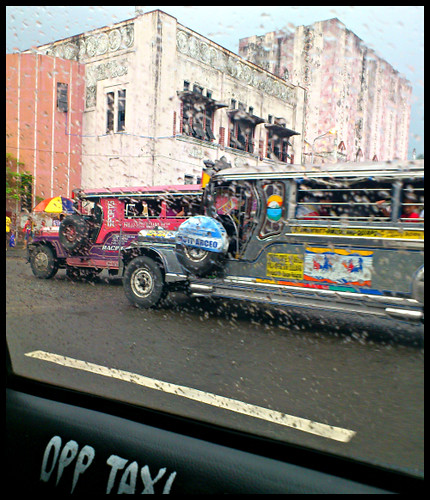
My strategy—the one that doesn’t involve alcohol—is to tire myself out as much as possible and be out for as long as I could, even if this means being aimlessly out and incredibly tired. This was the plan exactly when a few days ago I went downtown after work to shop for some holiday gifts. I rode a jeepney, a bus-like alternative to taxi, to get to Robinsons. On the way to the mall a young girl climbed in. 

Let me tell you about this girl. She was—what, seven? Eight? Young and feeble. She had this Dora-like mop of hair, and she was wearing an oversized yellow shirt with grey stripes. I noticed that she had a wart on her left eyelid that maybe looked like it needed surgery, and on her right arm she had another cauliflower-like growth. In her hand, she held a soft wad of red envelopes, kind of like what the Chinese use on Lunar New Year, except hers did not have Chinese characters.

She made her way through and passed the envelopes around and when she finished she backed off and stood on the single tread separating the speeding vehicle from asphalt. Clinging precariously to the chrome handrail at the back of the jeepney, she began to sing, and it lent her yellow shirt—raggedy and ill-fitting though it was—a new sunshiny splendor that I could not look away from.

The girl’s voice was soft and sounded drowsy. But it was the voice of an innocent. The thing is, she wasn’t even facing us when she sang. She was looking out and her audience was the wind, the world, the makings and manifestations of a life that perhaps has not been as kind to her as it has been to me. I have never had to sing for food, and if I did I would certainly always be starving.

And I know I already told you how much I hate Christmas songs. (Grinch may as well be my middle name, but honestly it’s all those minor seventh chords.) Well, this was the second time in as many weeks that I didn’t nervously run away from the music, that I actually listened and felt no irrational sadness or anxiety. The first was the time we spent assembling your Weihnachtsbaum in Santiago. I can’t really pinpoint what made the difference but I guess in both cases the presence of other people, of another person, reached parts of me that were not previously needed, that were perhaps unloved and unsung. 

Anyway, after her set of carols we, the passengers, gave the young girl a bit of change. She got off the jeepney somewhere between City Hall and the National Museum and jumped into another jeepney, the one I think trailing ours. That night, when I went to bed, I thought of her for a long time and wondered why it was always the most unlikely people who touched us most deeply. 

11 December 2012

Vineyard by the Sea


In a few days, I’ll be leaving Santiago and returning to Manila. This fact hit home when, late last week, I went to visit my barber one last time. Her name is Nataly. She’s in her late sixties or seventies and she’s married to the old, V-neck-sweater-wearing gentleman who runs the money changer next to her peluquería, on the ground floor of Crowne Plaza. She reminds me of Sally Fields. I say ‘barber’ but Nataly is what one may more appropriately call a ‘hairstylist’; I may be, for all I know, her only male customer. (Geographic incompetence had fortuitously led me to her instead of to some other, more traditional barbershop.) “Esta es mi última visita aquí,” I said to her, “porque tengo que volver a las Filipinas para la Navidad con mi familia.” After brushing and sweeping the hair off my shoulders, Nataly gave me a hug, as warm and soft and delicate a hug as only a meticulous silver-haired mestiza can give.

Don’t look too sad, she said. You’re going to be very happy to see your loved ones again. 

Nataly is not the only woman in Chile to whom I have said goodbye. There’s also red-haired Grandma, whose real name I still don’t know, even though she has served me lunch and offered seconds multiple times a week for the last several months in her humble Chilean—what to call it? carinderia? café? eatery?—her humble Chilean cafeteria, a block off Providencia on Monsignor Müller Street. There’s the kind Mapuche woman at the hotdog stand in Bellavista from whom I regularly order Chilean completos; she’s always smiling and she has the gentlest brown eyes in the world. There’s the marble-eyed cleaner who cleans our apartment once a week, whom I had once asked about a faulty laundromat, and whose Spanish-song-singing voice seems to float in the air, through the halls of the building I will soon stop calling home. But is it such a surprise that seeds grow where they have been scattered?

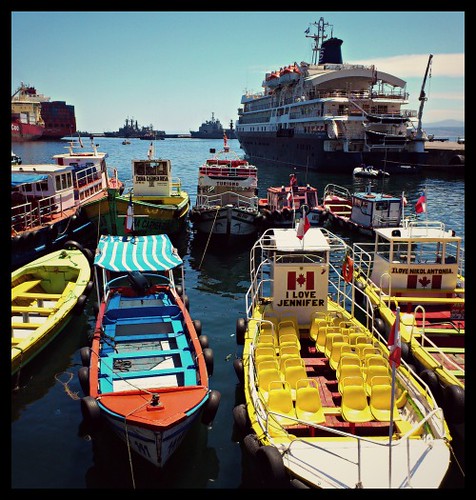
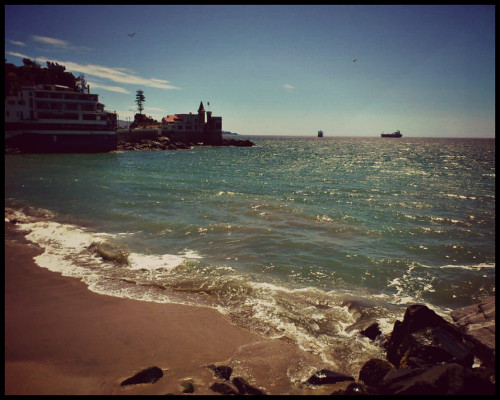
Then there’s her—Viña del Mar, about a hundred kilometers northwest of Santiago. She is so beautiful. I went to see her with my friend K from Hamburg and we drove up in a rental Chevy along Ruta 68, a winding highway that, once we reached Casablanca Valley, teasingly branched out to acres and acres of winery. (Why I waited until my second-to-the-last weekend to go for the first time, I couldn’t tell you.) The weather on that day was perfect. We rolled our windows down—eyeing and imagining verdant countrysides, Chardonnay plantations, voluminous grapevines, all the tangible joys of Chilean spring—until finally we approached the last of the hills and could smell the smell of the sea. 

First, we stopped at Valparaiso, Viña’s charming coastal neighbor, and got out of the car. There, an old, raggedy woman—bless her soul—approached us while we were sitting at an alfresco café. She was begging for alms but I did not have change. Then she asked for a cigarette, and I said I didn’t have any cigarettes left. The woman walked away, stopped at the corner of the street, looked back, and shouted to me (in accusatory English), “Your heart is very poor!” 

My heart is very poor all right. It is also very weak. This must have to do with having to leave. K, who, for work, spends months at a time in foreign cities (Santiago is as foreign to him as it is to me), wisely let me in on the dangers of attachment. “Saying goodbye is kind of like dying,” he said as we drove on. “You go back home, you think everything is the same, yet you are not the same. You are never the same.” I find indeed that with every act of farewell—however hurriedly it is performed, however disaffected and undemonstrative it is intended to appear—my heart breaks and I die a little.

The slayer is no brute. She is quite the opposite. Viña del Mar literally means “Vineyard by the Sea,” and she is also known as Chile’s “Garden City”—fondly, la ciudad jardín. Even though I only knew her for a short time—too short, in fact; an afternoon!—Viña del Mar is, for some reason I cannot explain (at least not with words), the one to whom I will have the most difficult time saying goodbye. Or could it be precisely because I only knew her for a short time, and no more than that? There is no guarantee that a hundred afternoons will be a hundred times better than one afternoon—or even as wonderful. We take what we have for what it is. And here’s what I have: an everlasting image of Viña’s greyish blue waters, her long stretches of white sand, those steady rocks that line her coast and tame the anxious tides of the Pacific. 

Before heading back to the city, K and I went to another café on the palm-lined oceanfront promenade, along which old couples ambled, children bicycled, lovers kissed. From there we could see Castillo Wulff, a granite German castle nestled magnificently on a rocky seaside cliff. It was the crowning touch to Viña’s beauty, which rallied me toward an exalted moment of restfulness and peace, while at once reminding me of the world that I had to love and leave.

And leave I did—exiting the shore, driving out of the carpark, heading toward the southeast, and dying a little once more.

09 November 2012

Bellas Artes


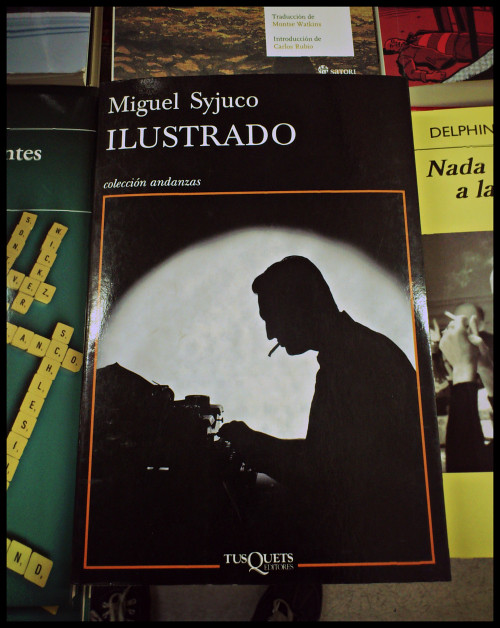
This afternoon in an area of Santiago called Bellas Artes I was thrilled to find a piece of home. Bouncing from bookstore to bookstore in search of English translations of Latin American novels, I spotted a Spanish translation of Miguel Syjuco's Ilustrado. It was buried under a stack of Allendes, Nerudas, and Fuguets. 

The name of the bookstore carrying the Syjuco is Metales Pesados (Heavy Metals). It's on Jose Miguel de La Barra, reportedly Santiago's version of Castro Street. I was cruising—cruising for books—and it thus pleased me to encounter, for the first time since coming to Chile, something veritably Filipino, something unforeign. The memory of a story I'd read and reread, reasserting itself eleven thousand miles later. There is otherwise nothing here that can be described as being from home or of home: there is not a single Filipino restaurant, a single Filipino work of art, a single Filipino anything. More than once I have wondered if I may as well be living in another planet. 

After asking the clerk the usual question of whether or not they sold novels in English (and getting the usual reply that no, he was sorry, they didn't), I made a point of showing him the Syjuco. “A novel by a Filipino,” I said (in my sorry Spanish), beaming with pride. “You and your customers ought to read it.” I placed the book on top of the stack, took a picture, and felt suddenly less transplanted than I had been these last few months. 

02 November 2012

Oro


First of all, fuck you. I hope you both lose at least one testicle someday, in the most horrible way possible. 

You're lucky I'm a foreigner, you know. An extranjero. I come from Manila, a tougher, rougher, harder city than Santiago. Just how much tougher, rougher, and harder? The location researcher for The Bourne Legacy, a film I haven't yet seen, saw it fit to shoot the bowel-loosening climax of that movie not many streets from where I live. Being Manileño, I would have engaged the two of you in an equally bowel-loosening chase scene and hounded you into the depths of Baquedano metro station. But not at all costs. After all, I was carrying my laptop. And my twenty-dollar Bench sneakers weren't fit for running. And the cars that were rolling along Costanera Norte seemed frightfully fast. (In other words, I chickened out.)

I would have at least cried for help so that a truckload of dashing carabineros could come and beat you both up. But I did not know how to say “Help!” or “My necklace!” in Spanish. It's such a shame; I really ought to try Rosetta Stone. Or hire a charming Spanish teacher—someone not from Chile, which even locals say is the worst place to learn Spanish, in the same way that perhaps the worst place to learn English in England is north of England, among the slag heaps. But whatever. Right now, the only thing I consistently remember how to say is, “Perdón, pero no entiendo bien el español.”

Speaking of pardon: you might want to ask it, too. Tsk-tsk, such a bad name you give Santiago. Instead of thinking endearingly of your city as the place where I have turned to some greasy heart attack in a bun—called as completo (“sin mayo, por favor!”)—for sustenance (thereby gaining, according to the scale, fifteen pounds in a month), I'll remember it as the site where I became for the first time in my life a victim of theft. And instead of regarding you as two of the better-looking Chilean twinks I have so far come across—don't be too flattered, I still wouldn't put you in a museum—I am now inclined to look out for your faces somewhere in Providencia, on a bridge over the Mapocho River, before one crosses Avenida Santa Maria, so that I, bolstered by the aid of carabineros, could crush said faces into looking like filleted mackerel. 

Up until this damnable incident it had been a nice quiet weekend for me. Even a nice quiet week. In fact, since coming to Santiago I have come to establish a sort of routine, and there is nothing I do outside of this routine that doesn't help keep me on an even keel. Monday to Friday, I work at Centro Movistar Innova. I start the day with non-Nescafé coffee at Baquedano (the old-fashioned diner, not the station) and when I head out to lunch, I usually end up at Grandma's on Monsignor Müller Street or the empanada store on Rodolfo Vergara. Predictably for groceries I go to the Walmart-owned Lider at the corner of Avenida Rancagua and Seminario. When I need a haircut I swing by Nataly's, which is at the commercial area on the ground floor of Crowne Plaza. On weekends I play basketball at Parque Araucano in Las Condes or do some much-needed reading at Café Literario Parque Bustamante. So genial and undemanding is this routine that portmanteaus like “Sanhattan” and “Chilecon Valley” have begun to sound cute and just right.

In fact, that fateful Saturday at the aforementioned library, I spent a happy couple of hours finishing Bad News, the second novel in Edward St. Aubyn's Patrick Melrose book series. While I am reluctant to liken Mr. St. Aubyn to Evelyn Waugh (whom I adore, by the way), it is easy to see why others have made the comparison, asserting that the former's savage writing and elegant wit are reminiscent of the latter's work. The prose is certainly delicious, and I was still savoring Mr. St. Aubyn's words when I emerged from Café Literario around seven in the evening and started to walk back towards our apartment in Bellavista.

At this time you must already have been in Plaza Italia, surveying the scene and keeping an eye out for anything that glittered. My necklace glittered. It was 24k, a gift from mother, who was smart and kind enough to let me wear a solution should I ever struggle against either emptiness of the pocket or dryness of the soul. Never mind how much it actually was: the necklace made me feel like a million dollars. It included a Mama Mary medallion that I kissed every time I felt happy or sad or on top of the world or disappearing from the world. I am not at all a religious man, but I did find that this regular act of kissing motherly gold somehow helped ease pains and intensify joys.

Friends say I was very stupid for wearing this necklace. I don't disagree. I was stupid. I was incredibly stupid for wearing it, but the thing is that I had not had problems before. (This is exactly what stupid people would say, I realize.) When you ripped the necklace off—as I was crossing the bridge over Mapocho River—the medallion fell to the ground, clinking. By then I had realized what the hell was going on. I picked the medallion up and turned around, ready to pounce, but what happened, really, was that I just stood there, limp and mute, close to crying like a wittle girl, less a Manileño than an extranjero, less an extranjero than a complete idiot. I watched you ugly little rascals escape and disappear while a random middle-aged couple slowly approached me and asked, “What was that all about?”

They were Australians on holidays. The wife was wearing nice earrings. I told them what that was all about, whereupon she nervously took off her nice earrings. Her husband reached out for her hand, and the three of us continued walking and talking until we reached Patio Bellavista, one block from my apartment. Before parting I put a word in for Backstage Experience, where they had to try the pizzas, they wouldn't be let down, or if not the pizzas then the fritto misto. Then I walked back home and kissed the medallion, and for the first time it didn't do anything; you two must have taken more than my necklace—who knows what and why and how—and run away with it, chortling.

21 October 2012

Jokes and Realities


"Money pads the edges of things," said Miss Schlegel. "God help those who have none."
"But this is something quite new!" said Mrs. Munt, who collected new ideas as a squirrel collects nuts, and was especially attracted by those that are portable.
"New for me; sensible people have acknowledged it for years. You and I and the Wilcoxes stand upon money as upon islands. It is so firm beneath our feet that we forget its very existence. It's only when we see some one near us tottering that we realise all that an independent income means. Last night, when we were talking up here round the fire, I began to think that the very soul of the world is economic, and that the lowest abyss is not the absence of love, but the absence of coin."
"I call that rather cynical."
"So do I. But Helen and I, we ought to remember, when we are tempted to criticise others, that we are standing on these islands, and that most of the others are down below the surface of the sea. The poor cannot always reach those whom they want to love, and they can hardly ever escape from those whom they love no longer. We rich can. Imagine the tragedy last June, if Helen and Paul Wilcox had been poor people, and couldn't invoke railways and motor-cars to part them."
"That's more like Socialism," said Mrs. Munt suspiciously.
"Call it what you like. I call it going through life with one's hand spread open on the table. I'm tired of these rich people who pretend to be poor, and think it shows a nice mind to ignore the piles of money that keep their feet above the waves. I stand each year upon six hundred pounds, and Helen upon the same, and Tibby will stand upon eight, and as fast as our pounds crumble away into the sea they are renewed—from the sea, yes, from the sea. And all our thoughts are the thoughts of six-hundred-pounders, and all our speeches; and because we don't want to steal umbrellas ourselves, we forget that below the sea people do want to steal them and do steal them sometimes, and that what's a joke up here is down there reality."

The above passage comes from Howards End, which I'm currently reading, along with Edward St Aubyn's Patrick Melrose series of novels (Never Mind, Bad News, Some Hope, Mother's Milk, and At Last). I can say in hindsight that it probably was not a good idea to read these books—English in very different ways—at the same time. (I prefer the Forster.)

Bringing books by English novelists to Chile was an even worse idea. Before coming to Santiago, I could have packed a Vargas Llosa (who is Peruvian-Spanish, by the way), a Bolaño, an Alberto Fuguet, or a Pablo Simonetti. Something Latin American, you know. Something un-English, thematically speaking. But of course I had no idea back then how difficult it would be to find an English-language bookstore in Santiago. The Chilean titles tickle me, but until I learn to read well in Spanish I can't scavenge the shelves the way I do in Manila. A couple of months ago, an interesting local who wrote poetry in French and admitted to disliking Neruda had pointed me to the direction of Takk (near Los Leones metro station) and Librería Alquimia on Manquehue Sur, but being extremely geographically challenged I have not found these bookstores. It's kind of sad. It'll be even sadder once I run out of English words to read.

08 October 2012

Something True


Recently I went to Fausto with M. She's from New York. It was sometime during the week of the Dieciocho celebrations in Chile, and there wasn't much to do except to party. The Providencia office was closed; so was the library. The metro was taking passengers, but where to go? The only places that remained open were the places that served liquor. So we decided to go to one. This is on Av. Santa Maria, next to a gasoline station, just past the hospital. However, the driver of the taxi we had jumped into didn't know where exactly the club was. I don't blame him. There aren't any signs outside the door. There aren't any banners or neon lights or loudly painted walls. If you can't find Fausto in the daytime you won't find it at half past midnight, which was the time that we went, M and I. 

I don't dance much. Actually, I don't dance at all—except probably in the shower. But dance I did that day, in the spirit of Dieciocho. Dance we did. Not the traditional cueca, mind you, but disco. Forget folk stylings and handkerchiefs; this house blasted Madonna, Kylie Minogue, Pitbull, Lady Gaga, Rihanna, that sort of thing. It wasn't exactly the most edifying playlist. Other people from other places in other times would laugh. But for these head-bangers both M and I were able to draw courage from the heady goodness of terremoto ("earthquake"), indeed a drink with shattering effects. Thus courageously and shatteringly did we move from the first-floor bar to the dance floor, from the dance floor up through the decadent marble staircase to the second-floor bar, from the second-floor bar to the other dance floor, which was wider and denser and darker and bigger and louder, while hours passed in the woozy blur of laser lights, cigarette smoke, and heavy bass lines.

Somewhere in a corner you saw somebody snogging another without seeing his face or knowing his name. Somewhere at the bar you heard drunken promises being uttered only to be broken in the morning. Somewhere on the floor you felt the random brushing of expensive tweed, cashmere, and corduroy, worn solely so that a handsome stranger could be teased into stripping them all off. Somewhere in the bathroom you understood that the effects of initials (Es, Vs, Ps) were being relished, that stuff was being divided into lines. It was reminiscent of college and after-college—of days that I had squandered largely by means of hallucination. I told M that I thought so. Does this not remind you of those days? And she said that it did, without offering a different story. 

At around five we finally went downstairs. We got our coats then sat again at the first-floor bar, watching a few more people file out of Fausto while in the background Rihanna chanted, we found love in a hopeless place, we found love in a hopeless place. This was when the couple came in. A middle-aged Chilean couple, probably in their late forties or early fifties. One had a well-groomed beard, the other was clean-shaven. One wore a simple V-neck sweater, the other a simple crew neck sweater. Both wore brogues. They literally swayed their way from the concierge to the bar—swayed slowly and ever so sweetly, at their own pace, to their own tune. They were smiling and holding hands and whispering in each other's ears. At some point, they realized that M and I were watching, whereupon the clean-shaven one turned to us and waved and said, "Hola!" with such unrestrained joy that it was all I could do not to shed a tear. Then they wrapped themselves up in an embrace and I was sure that whatever it was they were saying to each other, it didn't have to be sexy, it didn't have to be smooth, it didn't have to be grand. It only had to be true. The words and rhythms of two men who were done with settling for counterfeits.

M and I left Fausto before the sun came up. We decided not to take a taxi and walked instead towards Vicuña Mackenna, by the Baquedano roundabout, where we parted and went opposite directions and headed to the places in Santiago that we call home.

24 September 2012

Septiembre Once


Last September 11, I witnessed a terrible fire break out at Mall del Centro in Santiago. It started late in the evening, around ten or eleven, when I was with a couple of friends in their apartment, enjoying a good old bottle of Malbec from Mendoza. As soon as we heard the sound of sirens, we put our glasses down and looked out the window and saw, with our view from Diagonal Cervantes near Plaza de Armas, a steady plume of black smoke above Iglesia de Santo Domingo, rising into the night.

Soon more trucks came. Yellow tape was rolled out. News vans appeared and reporters and cameramen spilled out onto the street. Smartphones and cameras sprouted one by one from the windows of surrounding apartments. The Carabineros arrived. It was a fitting scene that drew to a close what to me—a clueless, silly foreigner come ten thousand miles from Southeast Asia—had been a profoundly strange day; a day of general disorder and disorientation. Half-faltering under the smoke and haze of wine and fire and cold and dark, I walked back to my building in Barrio Bellavista just before midnight, no less ignorant of what was going on around me than if I had simply stayed at home, read the news, and watched television.

Actually, we had been asked to stay at home. This was earlier in the day. “For your safety,” said the kind staff of Urban Station at Centro Movistar Innova, who each had walked from table to table to tell us, in slightly apologetic whispers, that the office would have to close before six. Certainly for good reason: on the outskirts of Santiago, public buses were being set on fire, hooded protesters were throwing metal chains onto power lines, Molotov cocktails were being hurled at police officers, supermarkets were being looted. Here's what I was not actually told: if, on September 11, Chile seemed farther from New York than it actually was—and if the distance to my home in the Philippines seemed somehow shorter than the entire stretch of the Pacific—it was because the day here meant something completely different. It had nothing to do with World Trade Center.

Before leaving the office, I read a Philippine Daily Inquirer piece by Benjamin Pimentel, a San Francisco-based journalist who wrote an open letter to “young Filipinos who never knew martial law and dictatorship”; it was thus a letter to me. “One thing you need to remember,” he wrote, “and perhaps we need to remind ourselves about this, too, (is that) those of us who joined the uprising to get rid of Marcos...didn't face riot police and the security forces thinking that the country's problems would suddenly disappear. We joined the fight to get rid of a tyrant. And guess what—we won. And you won.” If today, in the face of the annoying inefficiencies of the state, a number of young Filipinos were wont to dismiss the effects and rewards of having won yesterday—if one should go on to believe that Marcos wasn't, after all, so bad—Mr. Pimentel simply offered, “Trust me. It was much, much worse back then.”

Curiously, the Inquirer chose to run the piece not on September 21—the date martial law was declared in the Philippines—but on September 11—Marcos' birthdate and, here in Chile, the anniversary of the day Augusto Pinochet advanced upon La Moneda Palace and staged a coup against Salvador Allende. The coincidence, if it can be called that, was not lost on me, and made it impossible to resist drawing similarities between the periods of dictatorship in the Philippines and in Chile.

Indeed, there is something worthier of note than the amusing (and amused) reactions of Chileans upon hearing that my name is Juan Miguel, born and raised in a predominantly Catholic country, that I frequent Café Adriatico in Manila for their fabulous pollo a la pobre and divine estofado (downed with local cerveza negra), and that my childhood summers consisted of taking siestas and eating empanadas for merienda. The grander discoveries, at least for me, take place much later, as we go deeper in conversation, when the cumulative effects of Escudo and Crystal and Pisco Sour and Terremotos in the bloodstream finally bear upon the Chilean consciousness, when like a diary unbound one begins to recount the Pinochet days, starting from September 11, while in the background the guitarra fades out and the night eclipses the red, white, and blue of the bandera, and it becomes apparent that the women and men of Chile bear not just similar names but also similar scars, and carry equally heavy grudges, and remember still those times of inhumanity and unfreedom by beating their breasts and vowing, never again

(“But we don't like talking about politics in Chile,” said my friend S before downing a tall glass of Absolut orange. “For me it's just not fun.” A Filipino may as well have said that, and naturally S and I soon began to talk about politics.)

If both Marcos and Pinochet had won supporters over for their roles in developing economic policies that made the Philippines and Chile (to varying degrees) flourish, a question remains: but to what price? It's a question that I believe Filipinos like me—too naive, too young to understand, too far removed from the clutches of a dictator—should continue to ask and wonder about today. Arriving at answers may be beside the point; but perhaps we ought to allow ourselves to love and guard our freedom—however small and minor—a little more ferociously, a little more passionately, a little more honestly.

Before September 11 came to an end, I looked out again, this time from my bedroom window, and searched the cityscape for Mall del Centro—a piece of Santiago ablaze. I found out the next day that the fire had nothing to do with the protests; it was caused rather by faulty wiring.

29 August 2012

Tears


I saw her last week, on my way back from Valparaiso. It was close to ten at night, and I was on the train, the Metro de Santiago (headed towards Los Dominicos), sleepy and quite tired from the two-hour bus journey and thinking already of the nice little (albeit cold) walk from Baquedano station to our Barrio Bellavista apartment along Dardignac Street. She got on from Las Rejas, along with a few others, including whom I initially thought was her boyfriend but was actually, I soon figured out, her father. (They seemed very close, you see, and in Chile I find that being very close is often expressed in public displays of affection.) He had his back to me, so that as they talked I could see only her face. Like most Chileans, she spoke too fast—demasiado rápido—her loud, unguarded words like a burst fire of Spanish, rata-ta-ta, quite impossible for me to understand.

Still I couldn't help but listen in. I couldn't help but steal a glance whenever she crackled with laughter at something her father had said. It was the laughter of the young; indeed, she could not have been more than sixteen or seventeen. She kind of reminded me of a young Mena Suvari—in both American Beauty and Loser—plucky and capricious, with her blue American sweater, her black nose piercings, her loud auburn hair, her moody mascara, her red nail polish (that more than verged on being bold), her rugged brown leather bag, and, finally, her orange rolling luggage, which, as we thundered past station after station, she handled expertly with one hand and secured between her two sneakered feet.

Instantly I began to wish that I knew where she was going, and why. Perhaps she was off to study somewhere outside the city or country, or to spend the last of winter with distant relatives in a warmer place, or to find a good job, wherever the train took her, wherever the plane flew her. This was the only thing I'd become certain of: that she was headed to the airport. I was eavesdropping on a tender goodbye. The father, in his slickly gelled hair and black leather jacket, holding her hand, hugging her, kissing her, maybe with his hushed, fatherly Español (barely audible to anyone with manners) making her promise to take good care of herself; and so before long her tears replaced her laughter. She wiped them the way the youth often do: without care, without shame, and without fear.

I have since looked out for her face in the streets of Santiago, among the groups of students who seem these days to regularly clash with the police, protesting boisterously against the Chilean public education system. She could very easily belong here, in the middle of the crowds that gather at one of Santiago's many plazas—yet she couldn't. Her unrest must be of a different kind: less like theirs and more perhaps like mine. It is in any event a useless search: how can one find if one can't see? Just a couple of days ago, while walking around Plaza de Armas, I inhaled something in the air that began to make my eyes burn and my nose runny. It was tear gas, canisters of which, along with water cannons, are used by the police to subdue the student protesters. Later in the day I was convinced that the sense of panic I'd felt upon realizing what I inhaled was, in many ways, a kind of passage. A Chilean moment, if you will—my first. Ignorant of the science of lachrymators, as well as of the bigger goings-on in Santiago, I exaggerated the dangers of exposure to tear gas and, with calamitous nerves, snuck into a half-empty shopping mall, my face covered in a scarf.

Suffice it to say that I have not come across her again; I probably never will. Yet no matter how little I see or how blindly I roam, there is at least this memory, this mentally photographed image that I have, and can look upon, and surrender myself to, invariably rousing a raw, primitive feeling deep in my gut that, when she comes back, the young girl on the train will have grown into a woman.

22 August 2012

Dear Budoy, From Santiago with Love


I'm so sorry. It happened pretty fast. When C, my boss from Chicago (for whom I had worked only through the Internet), wrote to tell me that I was joining him in Santiago for the rest of the year to participate in some sort of business accelerator program, I had less than a week to get ready. He had booked the flights himself, but actually, up until then, I had no idea that I was going. Or I had the idea that I was not going—especially after weeks of not being able to find flights that worked, that didn't require more visas, that weren't ridiculously expensive. When his E-mail came it thus took me by surprise, which I then expressed tearfully while touching your face and rubbing your chest and stroking your hair. 

I hope you will forgive me despite this shy-making business of having told you one thing and doing another. Writing this letter probably won't make our separation any less damnable, but where I am here in Santiago, Chile, approximately 11,000 miles away from Manila, Philippines, my heart longs for you. Begs for you. Pines for you. I have fallen head over heels in love with you, Budoy.

People will say you're an askal, but who cares? Not me. You're not even a year old, yet you are already dearer to me than all the other dogs our family has had in the past. It isn't simply because you are handsome, of course. But do you know that in the right light you kind of look like a Jack Russell? Or so I'm convinced: that's why I couldn't stop taking pictures of you—in the garden, under the white van, in the living room, at the bottom of the staircase.

Before you came into my life, our family had had to deal with the unexpected deaths of a couple of Shih Tzu hybrids: Martin, whom we had to put down, and, about a year before him, Mitzie, Martin's mother. You'd think we'd been devastated enough by the loss of these two, but when late last year my Aunt Josie arrived from Pangasinan with you and your sister, there was no question, at least to my mind, about taking you both on. This was at the height of the popularity of a local telenovela on ABS-CBN starring Gerald Anderson, who played the title character named—you guessed it—Budoy. (Rest assured that you are handsomer.) In typical Filipino fashion, your sister was named Buday. 

Here's something you might remember from those days: a nasty fight broke out between you and Buday sometime during your first few weeks at home. Lots of squealing and scratching and barking and biting. We tried to stop the fight, even going so far as pouring a bucket of cold water over the two of you, but you wouldn't separate until, finally, you just did. When it was over, Aunt Josie found that she'd gotten a bad gash in her right wrist, which she began to wash with water and rub with garlic. It must have been Budoy, she said. Budoy got me. In fact, it wasn't you. I saw the whole thing. It was Buday, with her sharp fangs, and her uncanny strength, and her hard claws, and her beastly (as opposed to sisterly) qualities, who had struck Aunt Josie, and made you retreat to a corner with a whimper, down and defeated, blood dripping from somewhere—one of your legs, apparently—and sending me to the kitchen to search the cabinet for the Betadine and some cotton balls. 

Anyway, this turned out to be the least of your worry-making issues. You're a sickly dog, aren't you? Bless. Last February you had that parasitic infection that caused you to lose the hair on top of your head. (It was nice to watch it since grow back.) Last April you contacted canine distemper, the same viral disease that had killed Martin but which, fortunately, the vet was able to detect early in you. After spending two nights at the clinic in a steel cage with an IV, you seemed to have gotten over the worst of it, and were even barking enthusiastically in agreement, but the morning after your first night back home, when you were heading out to pee, you had to jump over a paved step, and the foreleg that had swollen from the drip burst open. There was blood all over the floor and pathway. I rushed you again to the vet's and by the time we arrived, my arms were covered in your blood, too.

The wounds took a couple of weeks to heal. Then, after deciding that you were finally healthy enough, I scheduled a round of vaccinations (including that for distemper)—your first. You must have hated me at the time, but to clear things up, I did it because I thought it would mean that you were soon going to be less prone to getting sick, that we were both finally going to enjoy more hours of sleep at night, that I was soon going to be able to take you again for a nice, pleasant Sunday walk in the park, and put your stuff in my backpack, and buy us a bottle of water from a concession stand in Luneta, and treat you, if you behaved, to a lick of ice cream. I was wrong. Before I could even plan a trip to the park, you began to lose your hair again. This time it was caused by sarcoptic mange, a kind of mite infestation, from which you have been trying to recover these last eight to ten weeks, including the days before I left. (Thank goodness for the shampoo that at least keeps the mange under control.)

I would wish you were here, Budoy, but as I figured out very quickly you cannot be hairless in Santiago. It is winter; the temperatures go no higher than 15 degrees C; I still shiver in my usual four to five layers of clothes, and I still see vapor coming out of my mouth when I breathe out. The stray dogs on the streets of Santiago—and there are many of them—all have thick hair, or are clothed in used sweaters, and are twice as meaty as you. (I have been told that they are seen by locals as angels of a sort—guiding, guarding, watching over people.) Nevertheless, when I look at them I am reminded of you, whom I miss very much, and would like to cuddle again very soon, in early December to be exact, just before Christmas, it won't be too long, my dear, it won't be too long.

P.S.: Last weekend I went to Valparaíso, a coastal city northeast of Santiago. There I visited one of Pablo Neruda's many houses, where I found a well-preserved poetry book that had fortuitously been opened to "Ode to the Dog" (Oda al Perro):

The dog is asking me a question
and I have no answer.
He dashes through the countryside and asks me
wordlessly,
and his eyes
are two moist question marks, two wet
inquiring flames,
but I do not answer
because I haven’t got the answer.
I have nothing to say….

The dog makes stops,
chases bees,
leaps over restless water,
listens to far-off
barking,
pees on a rock,
and presents me the tip of his snout
as if it were a gift:
it is the freshness of his love,
his message of love.
And he asks me
with both eyes:
why is it daytime? Why does night always fall?
why does spring bring
nothing
in its basket
for wandering dogs
but useless flowers,
flowers and more flowers?
This is how the dog
asks questions
and I do not reply.

Together we roam,
man and dog bound together again
by the bright green morning,
by the provocative empty solitude
in which we alone
exist,
this union of dog and dew
or poet and woods….
and the ancient friendship,
the joy
of being dog or being man
fused
in a single beast
that pads along on
six feet,
wagging
its dew-wet tail.

29 July 2012

India


I am not much of a cook; in fact, the culinary achievement of which I am most obscenely proud does not happen, really, to be particularly impressive. It was Rogan josh, made not from natural ingredients but from a lone sachet of curry paste I had rescued from a random grocery aisle. This, of course, remained unbeknownst to my guests—a lovely South African couple who have since moved to Dublin—until after dinner, by which time the kind compliments and several bottles of wine had relaxed me well enough to finally confess to my cheating ways. 

I share this only because lately I have once again been pretending to know Indian stuff—all sorts of it, and not just food. First I read Bharati Mukherjee's Miss New India, with its portrait of a small-town girl drawn toward the promise of increasingly metropolitan Bangalore. This came after (but not shortly after) my having read Upamanyu Chatterjee's English, August and Aravind Adiga's The White Tiger. Then I watched John Madden's The Best Exotic Marigold Hotel, which you probably already know is infinitely more English than Indian. (I did laugh out loud at Penelope Wilton giving new meaning to BLT, and at Dame Maggie Smith attempting to smuggle Branston pickles to sustain herself throughout her stay in Jaipur.) The next night, wondering if someone else's India could be as light-hearted and colorful as Mr. Madden's, I downloaded Wes Anderson's The Darjeeling Limited, which I think is an okay film, expectedly eccentric, but not quite as good as I'd hoped it would be, although of course I am under no authority to speak of films, and even less qualified to speak of India. Unlike in books, I can't say I have had an introduction to any sort of homegrown talent in film (Slumdog Millionaire is only slightly less English than Marigold), but I guess what intrigued me the most about both Marigold and Darjeeling was not how authentic both films were supposed to be, but how familiar they looked, at least to me, with their tales of the comedies and sorrows of migrant Westerners in the East. This is to say that if Mr. Madden's film is about the English, and Mr. Anderson's about the Americans, then both may as well have been about the English and the Americans in the Philippines.

Even if I don't recommend either, there is a golden one-liner in each of the films. "We haven't located us yet," blurts out a character in The Darjeeling Limited; meanwhile, in The Best Exotic Marigold Hotel, Ms. Wilton had the fortune of being given the line, "When I want your opinion, I'll give it to you." You've got to watch out for it!

Up next for me: Jerry Pinto's Em and the Big Hoom, recommended by an Indian friend whom I absolutely trust knows her stuff. I shall take notes as usual and write out what I think of the book. But first I have to find it.

16 July 2012

Plainsong


"The smudge pot they stood upright on the ground near the chute and Harold bent over stiffly and held a match to it. When it ignited he adjusted the flue so it gave off the heat, and its smoke rose black and smelling of kerosene into the wintry air, mixing with the cattle dust."

Kent Haruf's Plainsong is so beautiful. I love everything about how it is written: the prose is so simple, so unadorned, that I couldn't help but be taken in, even though I'd already read it previously, the first time about four or five years ago, and never remembered a thing about it, except for the part of the story about a pregnant teenage girl (Victoria Roubideaux). When I went to get my NBI clearance (a criminal record certificate) at Robinsons Otis and had to line up at six in the morning to secure my place in the queue (one has to sit on the floor, too!), my nose was in the book for three or four straight hours, making the wait very bearable.

One of the nicest things about Plainsong is that it's set in a small Colorado community, somewhere in the high plains called Holt, which means that the language used by Mr. Haruf is the language of this community's people. In 2009, Laura Miller wrote in Salon that American literature favors books about "men in boats" (over "women in houses")—Melville, anyone? Well, to me, books about men and women in a small town are just as charming, and the language just as lovely.

Take the passage above. It doesn't matter that I don't at all know a thing about what one does with cattle: as long as the farmers—here named Harold and Raymond McPheron, the old, unmarried brothers—know what they're doing with their cattle, I'm happy to read descriptions of them going about doing it. Thanks to Mr. Haruf, these happen to be rich, beautiful descriptions, too.

I'm also happy to be let in on a number of Americanisms—the kind that never annoys—which pepper the cuttings of talk in Plainsong. Here's an example: "Well, he might of went to Denver, Raymond said. Then he might of went back to the Rosebud in South Dakota. I doubt anybody knows. He's been gone a long time." "Might of went," of course, should be "might have gone," but who cares? Not me. When I read it, I heard it, too. It sounded like country music without the notes.