Showing posts with label Notes. Show all posts

14 April 2014

Summertime

But I can’t help remembering the first conversation you and I had, the first meaningful conversation. We must have been six years old. What the actual words were I don’t recall, but I know I was unburdening my heart to you, telling you everything about myself, all my hopes and longings. And all the time I was thinking, So this is what it means to be in love! Because — let me confess it — I was in love with you. And ever since that day, being in love with a woman has meant being free to say everything on my heart.

From Summertime by J.M. Coetzee.

12 March 2014

The Room Vibrates With It


In most of the men in a gay bar there is a greater responsiveness than is usual in the world outside, and though most of them make it a piece of strategy to restrain their response, and though the elements composing it are more often subtle than not—a shift of weight, an extra blink of the eyes, an effort not to look at something that naturally draws attention—its presence is palpable; the room vibrates with it. 

A few months ago I read Necessary Errors, Caleb Crain’s wonderful debut novel about a young American in 1990s Prague. It’s breathtaking, unpretentious, and, I think, important. Crain’s work reminds me an awful lot of Henry James’, and his novel is just the kind of novel I’d like to be able to someday write. Since then I have been reading a collection of short stories called The Other Persuasion, a collection edited by Seymour Kleinberg, featuring, among many others, Marcel Proust, William Faulkner, E.M. Forster, Gore Vidal, Gertrude Stein, and D.H. Lawrence. (The Proust and Vidal stand out.) On these two books I’ve been taking more notes than usual—thank you, Evernote! And even though I know it seems that way I don’t make it a point to read gay fiction, only that it’s the kind of thing I find most interesting at the moment.

Why? My friend R has a theory. “Like women, gay men have to pay attention to the world around them in order to avoid harm,” he wrote to me. “This makes their writing better. But heightened attentiveness is all I would allow to characterize ‘gay fiction.’ Who knows what gay writers will do when there is little or no reason to conceal being gay?”

23 October 2013

Describe Away


I have forgotten every New Year’s Eve but two, I have forgotten what my dead brother looked like at the age of nine or ten or twelve, but I will never forget the three little facts the nice people in Brighton told me about the body that they pulled from the sea.  
The first is that Liam was wearing a short fluorescent yellow jacket when he died, like the ones railway workers and cyclists wear.  
The second is that he had stones in his pockets. 
The third is that he had no underpants on under his jeans, and no socks in his leather shoes. 
The tides in Brighton are fast and they range far. He wore the jacket so he would be seen going into the water, and his body would be easily found. Liam, who could not organise a box of matches, was, on this occasion, fully organised.  
The stones explain themselves. 
It is the lack of underpants that makes me cry. Liam was never together, but he was always clean, and though he lived in various pits, they always had running water, he always knew where the nearest launderette might be found. He used an old-fashioned pink soap, with an industrial smell—I have no idea what it was called. I remember standing in the supermarket sniffing all the bars through the paper, ending up with some odourless stuff which he would not use. He put Coal Tar shampoo on his hair, and Listerine on his gums. He sprinkled anti-fungal powder everywhere and made demands for wet wipes beside the toilet. He flossed. His anti-perspirant would strip paint. 
Liam took his underpants off because they were not clean. He took his socks off because they were not clean. He probably thought, as the cold water flooded his shoes, cleansing thoughts.  
I know, as I write about these three things: the jacket, the stones, and my brother’s nakedness underneath his clothes, that they require me to deal in facts. It is time to put an end to the shifting stories and the waking dreams. It is time to call an end to romance and just say what happened in Ada’s house, the year that I was eight and Liam was barely nine.  

The Gathering is a wonderful novel. But it’s not my kind of wonderful novel—at least not right now. I mean to say that timing likely has a lot to do with taste. As literary agent Jonny Geller says, “You read some books at the wrong time in your life. It’s not their fault.”

It’s the wrong time in my life, so it’s not Anne Enright’s fault. I happened to start reading The Gathering just after I bought a copy of Necessary Errors, Caleb Crain’s debut novel. Naturally, I wanted to immediately read the Crain (have you read James Wood’s glowing review in the New Yorker?), and to not get involved in anything that would distract me from it. But I’d already begun the Enright, and I didn’t want to not finish it. Meanwhile, the new Donna Tartt came out, and Alice Munro won the Nobel Prize, and Eleanor Catton, for her The Luminaries, won the Booker, an award that Enright herself took in 2007 for The Gathering. So there were three female authors I suddenly became more interested in reading than I was in reading Enright. It’s kind of embarrassing to admit, but I probably didn’t give The Gathering the attention it deserves.

The wrong time: my father also got sick. The Gathering, which really is a story about the horrors and wonders of love (among members of a big Irish family, the Hegartys)—or, in A.L. Kennedy’s own words, of “love’s stupidity—an outpouring of energy towards people who are always destined to disappoint, to be disappointed and, above all, who are compelled to leave us in the most devastating way, by dying”—The Gathering became a book that I couldn’t bear to read in the hospital, no matter how lyrically the story is told. Which isn’t to say that I didn’t decide to labor over it anyway. (The word ‘labor’ is unfair; if there’s one thing I can learn from Enright and Munro, it’s the amazing carefulness with which they choose their words—a carefulness that makes the former’s voice as Irish as the latter’s is Canadian.) I’ll probably read it again, but not anytime soon—maybe when I reach a time or the age when I have much more patience. 

In any event, I won’t attempt a critique now. And I definitely won’t share some people’s opinion that Enright’s descriptions of the narrator’s husband’s flaccid penis were unnecessary—this is a genital novel, full of dark, sad entanglements of bodies, bones, skin, and sex. Describe away! 

28 July 2013

Look at the View


Robert imagined his mother talking to him when he had been sealed up in her womb. Of course he wouldn’t have known what her blunted syllables were meant to mean, but he was sure he would have felt a current flowing between them, the contraction of a fear, the stretch of an intention. Thomas was still close to those transfusions of feeling; Robert was getting explanations instead. Thomas still knew how to understand the silent language which Robert had almost lost as the wild margins of his mind fell under the sway of the verbal empire. He was standing on a ridge, about to surge downhill, getting faster, getting taller, getting more words, getting bigger and bigger explanations, cheering all the way. Now Thomas had made him glance backwards and lower his sword for a moment while he noticed everything that he had lost as well. He had become so caught up in building sentences that he had almost forgotten the barbaric days when thinking was like a splash of colour landing on a page. Looking back, he could still see it: living in what would now feel like pauses: when you first open the curtains and see the whole landscape covered in snow and you catch your breath and pause before breathing out again. He couldn’t get the whole thing back, but maybe he wouldn’t rush down the slope quite yet, maybe he would sit down and look at the view.

From Mother’s Milk, by Edward St. Aubyn.

31 May 2013

Yet I Shall Kill Thee with Much Cherishing


On this latest trip to Thailand I brought light reading with me—light in content and light in weight. My baggage allowance, the minimum on a budget airline, did not allow for more books. (Or more anything.) So I brought only my Kindle and a friend’s copy of The Boy from Beirut and Other Stories by Robin Maugham. I thought these would do for a couple of weeks, most of which I knew anyway would be spent not reading. 

Anyway, there’s a very interesting interview with Maugham at the end of this book, edited by the late Peter Burton, which my friend recommended I check out. So I did. I have not yet actually read any of the stories—I have been reading at the pace of someone in a deck chair on the shores of west coast Phuket (very lazily and distractedly, that is to say)—but the interview, I found, is worth missing eye candy at the beach for. Maugham talks about his renowned uncle, W. Somerset, whose writerly footsteps he followed, and in whose shadows, whether he liked it or not, the younger Maugham grew up. On when he first became aware that “Willie” was gay, he says, “I went to Vienna to study the piano, in between leaving Eton and going up to Cambridge, and there I suddenly found that Willie was famous. Then of course his secretary and beloved friend Gerald Haxton came out and tried to seduce me. So long before I went to Cambridge I knew all about it. I mean...about them.”

Meanwhile, asked by Burton on whether his own relationships have been easy or difficult, Maugham says, “You see, a writer is in an awfully difficult position, because he’s got to work alone, except in very rare cases of book collaboration, and loneliness is occupational—is the occupational disease—sorry, disadvantage, of a writer. A writer’s...yes, occupational disadvantage is loneliness, and if you take Willie, for instance, he built himself a writing room on the top of the Villa Mauresque, Cap Ferrat—a kind of ivory tower you might say.... You couldn’t get to it except up a small passage and by walking across the roof. He would withdraw there. He’d even blocked out the view across Villefranche Bay, blocked it out so that nothing should disturb his concentration.... He’d come down for a cocktail before lunch. But when he was in the middle of a book he admitted that the characters which he was describing were more real than the characters of real life around him. And this, of course, didn’t make for a happy life with his companion and lover Gerald Haxton, who couldn’t help resenting the fact that he played only a peripheral part in Willie’s life. The essential part was Willie’s writing and although in his way he loved Gerald desperately, he couldn’t give all of himself to Gerald because he had to reserve the most important part for his work.”

I wouldn’t say I believe this to be true—that writers are, or could be, bad lovers—or at least I wouldn’t admit so readily that I believe this to be true. It can’t be! But I know that it could be. My own relationships have so far been difficult. That’s why I remain open that writing may not be for me—that this loneliness, this occupational disadvantage, is not permanent, after all—although I frankly cannot imagine doing anything else but write, if only because I am worse at everything else.

Anyway, the one other thing I just finished reading is a poem: Wilde’s The Ballad of Reading Gaol. It is a strange thing to be reading a—well, a “prison poem” on an island with beautiful views of sea and infinite sky. But there you go. Below you’ll find a passage that I have since been trying to memorize. Though the context is different, it’s reminiscent, I think, of the line, “Yet I should kill thee with much cherishing...” See what I mean:

Yet each man kills the thing he loves,
By each let this be heard,
Some do it with a bitter look,
Some with a flattering word,
The coward does it with a kiss,
The brave man with a sword!

Some kill their love when they are young,
And some when they are old;
Some strangle with the hands of Lust,
Some with the hands of Gold:
The kindest use a knife, because
The dead so soon grow cold.

Some love too little, some too long,
Some sell, and others buy;
Some do the deed with many tears,
And some without a sigh:
For each man kills the thing he loves,
Yet each man does not die.

07 May 2013

In a Strange Room


Nothing could have prepared for me for Damon Galgut’s In a Strange Room. In the end, nothing did. I finished the novel in a day and a half at home. It is astonishing. Its effect on me was physical. It made my palms sweat. I stayed up to read and did not sleep. I moved from the bed to the couch to the kitchen to the swivel chair then back to the bed. I burst into tears. (My dog Budoy came in and extended his leg more than once to console me.) In the middle of the third story—“The Guardian” (the novel is divided into three sections)—I slapped the book shut and decided to go up to the balcony and lift weights. I’m useless at lifting weights. But I felt like I had to: mainly to keep my distance. If this sounds awfully dramatic—I’m only talking about a book, correct?—forgive me. I can’t tell you why, unless you’ve read it yourself, and even then, I can only tell you that Anna, the narrator’s destructive friend, reminds me of someone in my own life, never mind that the story in which she figures—the third, yes, “The Guardian”—seems to be the story with which the critics were not very enchanted. But who cares about the critics anyway.

In a Strange Room (the title should ring a bell to anyone who has read Faulkner’s As I Lay Dying) was lent to me by a friend who’d put his copy in a paper bag that he handed to me a couple of weeks ago. Also inside were The Boy from Beirut and Other Stories by Robin Maugham (nephew of the famous W. Somerset) and A Separate Peace by John Knowles. Judging these books by their covers, I think I ought to read the Maugham next. I could use a little cheering up! And from what I heard, Lord Maugham was a bit Wilde, a bit Waugh. 

04 May 2013

A Home at the End of the World


At dinner, we talk about the restaurant and the baby. Lately our lives are devoted to the actual—we worry over Rebecca’s cough and the delivery of our used-but-refurbished walk-in refrigerator. I am beginning to understand the true difference between youth and age. Young people have time to make plans and think of new ideas. Older people need their whole energy to keep up with what’s already been set in motion.

A couple of weeks ago I met up with a friend who was kind enough to lend me his signed copy of A Home at the End of the World, by Michael Cunningham. “You haven’t read this, have you?” W asked. I told him I hadn’t; the only Cunningham I’d ever read was, naturally, The Hours. The next day I Googled the title and realized that, like The Hours, A Home at the End of the World had been made into a movie, too—featuring Colin Farrell, Robin Wright Penn, and Sissy Spacek (who starred in In the Bedroom, one of my favorite films). The screenplay was also written by Cunningham, who, I must say, has such a lovely signature that it should be turned into a font type.

There is so much to read, isn’t there? I find this to be truer every day. And every day there is less time than the previous day to read more, to do more, to catch up, to make the most of what’s left. It was with this feeling of hourglass urgency that I read the Cunningham at a faster pace than usual. A few pages into Part III, from which the above passage is taken, I received, again from W, three more books, each of which I also plan to read as quickly as I can. In exchange I lent him André Aciman’s Call Me by Your Name, in part because he told me he’d been reading Proust, of which Aciman is a sort of scholar. 

Anyway, about A Home at the End of the World: it’s a book, I think, that’s so full of love. I think I like it better than The Hours, and that’s saying a lot. Cunningham’s prose here is pretty, but his story is honest and raw. It made me cry a few times, none more unabashedly than when young Jonathan Glover walked into his parent’s bedroom after a fight between his mother (Alice) and father (Ned). He came upon his father lying across the double bed.

He could have picked me up and taken me onto the bed with him. That gesture might have rescued us both, at least for the time being. I ached for it. I’d have given everything I imagined owning, in my greediest fantasies, to have been pulled into bed with him and held, as he’d held me while the sky exploded over our heads on the Fourth of July. 

28 April 2013

The Anti-Bildungsroman


I’m reading something else—Michael Cunningham’s A Home at the End of the World—but I haven’t stopped thinking about Madame Bovary. I think I know why. A literary friend had written to me to say that he’d read the Flaubert (in the original French) three times—the first time as a twenty-something, when he still “knew nothing about life”; it occurred to me that my own experience of reading the novel could very well be influenced by where I am in my own life. 

After all, it is often true what some scholars say: the great books seem to be written for the reader and the reader alone. I am aware of the position of a book called The Perpetual Orgy by Mario Vargas Llosa (to which this friend had tipped me, saying he didn’t quite agree with the Peruvian-Spanish writer’s love for Emma Bovary), but I have not actually read it. I do have my own opinion of Emma. It’s not a very high one, and I certainly see her with less reverence than does Vargas Llosa. It has nothing to do with her cheating ways; it has to do with her being fatally romantic. To me, therefore, Madame Bovary is the anti-bildungsroman. Emma never comes of age. She remained as she was, as she had always been, until the day that she died (or killed herself). That Flaubert could craft a perfect novel (or as close to it as one might imagine) from having this woman as his central character demonstrates his astounding achievement. He never judges her, and he leaves it entirely up to us, the readers, to do so, if we could be so willing. And if we do judge these characters, it will perhaps say more about us—about where we are in the time that we read it—than about anyone else in the book.

Neither does Flaubert judge Charles Bovary, whom I have written about as the character I rooted for. He’s not up to much as a literary character—can anyone be less interesting?—but with a moral view of things, one will be hard-pressed to find fault in him. (Speaking of dull, I read somewhere that Flaubert wrote Madame Bovary as a way of taking on a challenge posed by friends or colleagues: to write a novel based on very dull characters. I’m not sure if this is true, but it makes perfect sense if it is.)

Like my friend, I’ll probably re-read Madame Bovary when I’m in a different place. I’m sure that by then the book will seem entirely new.

25 March 2013

Out of the Game


I must be getting old. (Which is okay, by the way.) Recently, encouraged by Roger Rosenblatt’s New York Times piece on the best movies about a writer, I watched the film adaptation of Starting Out in the Evening, which is based on a novel by Brian Morton. To my horror, then not so much, I found that I could see myself more in the old, writerly Leonard Schiller character (played by Frank Langella) than in the young, student-y, brimming-with-enthusiasm Heather Wolfe (played by fire-haired Lauren Ambrose). Not because Schiller is a writer, which I claim to be (besides, so is Wolfe—she’s writing her thesis), but because Schiller is old—older—and would rather not suffer from the intense but short attentions of young people. 

This is not to say that I regularly attract young—younger—people’s attention. I don’t. Of the intense kind, I attract even less. I only mean that if I do, I won’t be able to keep up with it. I know so! As Rufus sings, not too sadly, “I’m out of the game.” And the game, whatever it was, was invariably something I’d be useless at playing in the first place. 

If this sounds outlandish and awfully ageist, forgive me. But it’s true. A few days ago in a bar I met a pair of backpackers barely out of their teens and, next to them, I could positively hear my bones creaking. One was from France, the other from Denmark, and they began to talk to me about beer—the beers of the world. It was a conversation that lasted close to three hours, felt longer (much!), and involved voluntarily dished out lists of breweries visited, places sojourned in, cultures absorbed, exotic foods sampled, sexual encounters had, wealth squandered and wealth accumulated; it was, in short, the kind of conversation that was not about beer, really. It was about being young, wild, and free (or Eat, Pray, Love as told by two guys in a room). I made less than a little contribution to it. Here’s an old-person skill I did not use to have: I managed to talk without actually saying anything.

Now if only I can find people who’ll tell me something about books instead of beer. Or about Starting Out in the Evening. About anything! As long as it brings to the surface how one thinks instead of what one thinks. Also: age doesn’t matter, as long as it doesn’t get in the way. I thought I’d find friends in bars. Obviously not! But I’m only half-kidding, which goes to show that I don’t know as much as I think I do—a fact that to me will be clearer in a few years, and much, much clearer in a lot of years.

07 March 2013

We Must Not Touch Our Idols


We must not touch our idols; the gilt sticks to our fingers.

I just finished reading Madame Bovary. (Phew!) It took a long time. It took three sleepless nights to get through the last part. By the end of the third night, I was crying. Flaubert had me. For whom were these tears, you might ask? For Charles Bovary, Emma’s husband. 

So what if Charles is common, unsophisticated, not intellectual? He is a good man. He is kind, hardworking, loyal. That’s the most important thing, isn’t it? That’s all one can ask for from a man—from a spouse. Few deserve Charles. Emma doesn’t. I certainly don’t. (Not that it’s a matter of what one deserves.) But it’s funny because I wrote recently to a friend about how I could identify with Emma, who is irresponsible and a total romantic, who lapses into boredom, sickness, and depression whenever reality fails to match her ideas. (It’s awful, but that’s me. I touch idols until inevitably they cease to be idols.) And yet in the end it was Charles for whom I was suddenly rooting. It was for him that I was suddenly feeling.

One of the most interesting things about the creation of Madame Bovary is that the first English translation of it—that which I read—was produced by Eleanor Marx, the youngest daughter of Karl Marx. If you’ve read the novel, the story of Eleanor’s death will sound horribly familiar. She was sickened by, among other things, a love affair: this was with socialist campaigner Edward Aveling. So sickened was she that she decided to send her maid Gertrude to the chemist for chloroform and hydrogen cyanide. Eleanor swallowed the poison in the privacy of her room. Unlike Emma, however, she actually had time to pen a final billet-doux. “Dear, it will soon be all over now,” she wrote in her suicide note to Edward. “My last word to you is the same that I have said during all these long, sad years: love.”

25 February 2013

Bereft


It was with shock that I read about the recent death of a schoolmate—the sudden death, only a few days ago, of a man whom I had not seen since our high school graduation in 2001. According to the news report, he was killed when the wayward jeepney in which he was riding tipped over and fell on its side—his side. He was twenty-nine.

We weren’t friends exactly; I can’t recall him ever speaking to me, or me to him, although we must have spoken to each other at one point or another. We did go to school together, starting from kindergarten at the old Little Angels in Quezon City, where we, I remember, were classmates. So in a way his face was a fixture in the scenes of my childhood. We grew up together, in a way. This must explain part of the shock: he could have been a friend of old. That he wasn’t—that I knew him only through other friends, from a place and time I don’t terribly miss—does not make his death any less shocking. It doesn’t make me feel less sad. Anyone his age is too young to die.

I do wonder if such terrible news could be made less terrible if one didn’t find out about it through Facebook. I was, in fact, Facebook friends with the deceased. We had over a hundred mutual friends. I’d gotten so used to seeing or hearing about others’ birthdays, romances, breakups, engagements, weddings, babies, promotions, habits, diets, travels, pleasures, parties, possessions—their proofs of life—that the announcement of someone’s death, a proof of the end of someone’s life, came as something entirely unexpected. When the “Rest in peace” posts began to appear on my News Feed—posts written by fellow schoolmates—my heart jumped. Then I felt embarrassed. I realized with sudden horror that Facebook was a massive cocktail party and I had just followed a crowd into a private room with a casket in the middle. Is there a clumsier way of having this sort of news broken? I think not. You could be holding a martini in your hand while everyone else is consoling the bereaved. 

11 January 2013

Drag


Last time I saw you
We had just split in two.
You were looking at me.
I was looking at you.
You had a way so familiar,
But I could not recognize,
‘Cause you had blood on your face;
I had blood in my eyes.
But I could swear by your expression
That the pain down in your soul
Was the same as the one down in mine.
That’s the pain,
(That) cuts a straight line
Down through the heart;
We call it love.

— From “The Origin of Love”

Ever heard of To Wong Foo, Thanks for Everything! Julie Newmar? It’s a movie that I watched when I was a young boy. HBO had shown it a bunch of times, sometimes twice in one day. So I watched it a bunch of times, too. (In those days—we’re talking mid to late nineties here—I preferred to stay awake while everyone took their siestas.) Back then, I, being no more than twelve or thirteen, didn’t really understand what the movie was about. It was lost on me. (As was everything else possibly important in my misspent youth.) But I do remember how I felt seeing Wesley Snipes, Patrick Swayze, and John Leguizamo in drag. I felt startled. Men dressed up as women! My Christian Living teachers would not have approved of it.

I was also held spellbound. 

I bring up To Wong Foo because recently—between hours of listening to Georgette Dee and Frank Ocean—I watched The Adventures of Priscilla, Queen of the Desert and Hedwig and the Angry Inch. Both of these are—how do you describe it?—both are drag queen movies. They kind of brought back the same feelings that I had had watching To Wong Foo as a kid. Hugo Weaving, Terence Stamp, and Guy Pearce were freaking fabulous in the former; and if I start with John Cameron Mitchell in the latter, I will not run out of good things to say. He was simply terrific as the title character, a transsexual singer from Berlin supposed to represent, metaphorically speaking, the old divide between communist East Germany and democratic West Germany. The story is more philosophical than political, though. If you haven’t seen Hedwig and the Angry Inch—well, I would at least recommend that you look for and listen to “The Origin of Love,” one of the songs from the original stage show (the film is an adaptation of a musical by Stephen Trask), which is based on Aristophanes’ speech in Plato’s Symposium. The sound, I daresay, is Bowie-esque. The lyrics are even nicer.

Are all drag queen movies supposed to be preposterous? I won’t pretend to have an opinion on the matter. (People who know me, however, will hasten to tell you that I can be either a drag or a queen!) Besides, if they are, it’s probably because they’re only being faithful to the dramas and realities of drag queenship. A couple of months ago, I was hanging out with my dear friend M at a local bar on Pio Nono in Santiago, Chile, and we came across this dancing man-woman who touched, or attempted to touch, the ass of every male passerby. It was a hoot. Escudo almost came out of my nostrils, and M and I had as good a time as she did. She was dancing, shaking, sashaying in this glittered lavender ensemble, complete with bold red lipstick, a classic blonde wig, and heels that clattered, and she reminded me, not with words but with appearance and action, that I took life way too seriously, that I ought to have fun once in a while, you know? The way she was having fun. Someone gave her a quiniento—an insult to her talent, apparently—and she just tossed it in the air and proceeded to grab the shirt of a random Chileno for a few minutes of non-traditional street-side cueca. Again I was held spellbound, but no longer was I startled. 

29 December 2012

Solitude


...love your solitude and bear with sweet-sounding lamentation the suffering it causes you. For those who are near you are far, you say, and that shows it is beginning to grow wide about you. And when what is near you is far, then your distance is already among the stars....
...your solitude will be a hold and home for you even amid very unfamiliar conditions and from there you will find all your ways. 

While living and working in Chile, I picked up a habit of reading several books at the same time. It was not something I was used to doing, so more than one book was one or more books too many, especially given my extremely short attention span. I can’t say that I accomplished anything by doing this; even worse, I can’t figure out why I did it in the first place. But I started with Edward St Aubyn’s series of Patrick Melrose novels, and it took forever to get to At Last. That’s because I was also reading Howards End and Bouvard et Pécuchet on my phone, and a random selection of essays by Cynthia Ozick on my computer, and The House of the Dead (a tattered copy of which I bought from Libros El Cid Campeador on Merced Street), and stories from Colm Tóibín’s Mothers and Sons collection, and, later on, after mi jefe C had given me a Kindle, Justin Halpern’s Sh*t My Dad Says. (Guess which one entertained the most.)

For my return flight to Manila I thus resolved to stick to one book, Rainer Maria Rilke’s Letters to a Young Poet, from which the above passage comes. I like writing letters, and I love reading them even more. About four years ago I read the 700-plus-page Decca: The Letters of Jessica Mitford, which proved to be at once a hoot and treasure, and instantly made me want to be a more outstanding correspondent; the book was given to me by a friend in New York. The Rilke, meanwhile, was given by another friend, who told me about another passage (from the same collection of letters) that I agreed was pretty useful advice for writers. (Identification of this other passage upon request.) He added a Flavia Weedn quote as his dedication, and it is the exact same quote that was printed on a bedroom poster (of a bear) that I had when I was a kid. (Identification of quote also upon request.)

So anyway: I read the Rilke in the time that it took to get from Santiago to Manila. My stops were São Paulo, Dubai, and Kuala Lumpur. After several months in Chile of not hearing another human being speak Tagalog, I was relieved to hear and see Filipinos at the Dubai International Airport. But I never did move to speak to them. The book absorbed me completely, and even though I had not given Rilke’s poems a try, I was glad to have his letters, which made the forty-hour journey somehow shorter.

09 November 2012

Bellas Artes


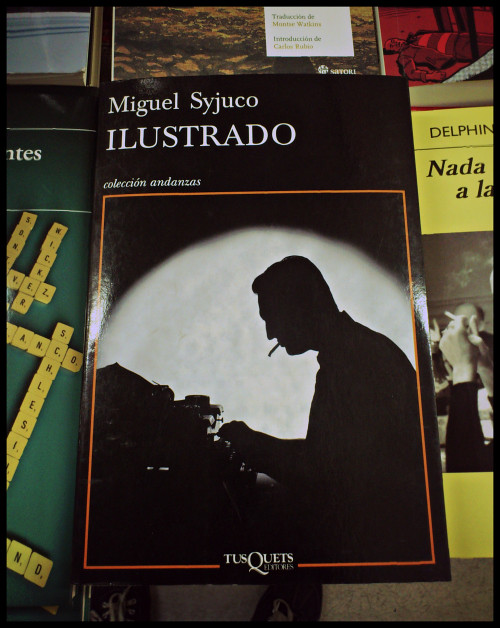
This afternoon in an area of Santiago called Bellas Artes I was thrilled to find a piece of home. Bouncing from bookstore to bookstore in search of English translations of Latin American novels, I spotted a Spanish translation of Miguel Syjuco's Ilustrado. It was buried under a stack of Allendes, Nerudas, and Fuguets. 

The name of the bookstore carrying the Syjuco is Metales Pesados (Heavy Metals). It's on Jose Miguel de La Barra, reportedly Santiago's version of Castro Street. I was cruising—cruising for books—and it thus pleased me to encounter, for the first time since coming to Chile, something veritably Filipino, something unforeign. The memory of a story I'd read and reread, reasserting itself eleven thousand miles later. There is otherwise nothing here that can be described as being from home or of home: there is not a single Filipino restaurant, a single Filipino work of art, a single Filipino anything. More than once I have wondered if I may as well be living in another planet. 

After asking the clerk the usual question of whether or not they sold novels in English (and getting the usual reply that no, he was sorry, they didn't), I made a point of showing him the Syjuco. “A novel by a Filipino,” I said (in my sorry Spanish), beaming with pride. “You and your customers ought to read it.” I placed the book on top of the stack, took a picture, and felt suddenly less transplanted than I had been these last few months. 

21 October 2012

Jokes and Realities


"Money pads the edges of things," said Miss Schlegel. "God help those who have none."
"But this is something quite new!" said Mrs. Munt, who collected new ideas as a squirrel collects nuts, and was especially attracted by those that are portable.
"New for me; sensible people have acknowledged it for years. You and I and the Wilcoxes stand upon money as upon islands. It is so firm beneath our feet that we forget its very existence. It's only when we see some one near us tottering that we realise all that an independent income means. Last night, when we were talking up here round the fire, I began to think that the very soul of the world is economic, and that the lowest abyss is not the absence of love, but the absence of coin."
"I call that rather cynical."
"So do I. But Helen and I, we ought to remember, when we are tempted to criticise others, that we are standing on these islands, and that most of the others are down below the surface of the sea. The poor cannot always reach those whom they want to love, and they can hardly ever escape from those whom they love no longer. We rich can. Imagine the tragedy last June, if Helen and Paul Wilcox had been poor people, and couldn't invoke railways and motor-cars to part them."
"That's more like Socialism," said Mrs. Munt suspiciously.
"Call it what you like. I call it going through life with one's hand spread open on the table. I'm tired of these rich people who pretend to be poor, and think it shows a nice mind to ignore the piles of money that keep their feet above the waves. I stand each year upon six hundred pounds, and Helen upon the same, and Tibby will stand upon eight, and as fast as our pounds crumble away into the sea they are renewed—from the sea, yes, from the sea. And all our thoughts are the thoughts of six-hundred-pounders, and all our speeches; and because we don't want to steal umbrellas ourselves, we forget that below the sea people do want to steal them and do steal them sometimes, and that what's a joke up here is down there reality."

The above passage comes from Howards End, which I'm currently reading, along with Edward St Aubyn's Patrick Melrose series of novels (Never Mind, Bad News, Some Hope, Mother's Milk, and At Last). I can say in hindsight that it probably was not a good idea to read these books—English in very different ways—at the same time. (I prefer the Forster.)

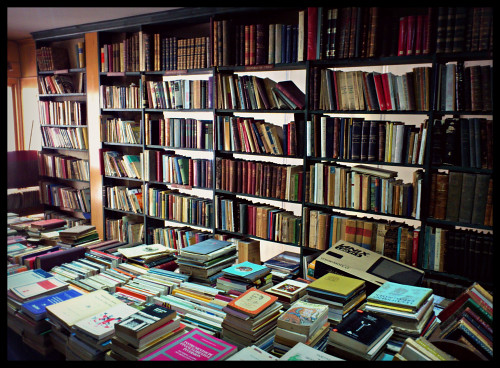
Bringing books by English novelists to Chile was an even worse idea. Before coming to Santiago, I could have packed a Vargas Llosa (who is Peruvian-Spanish, by the way), a Bolaño, an Alberto Fuguet, or a Pablo Simonetti. Something Latin American, you know. Something un-English, thematically speaking. But of course I had no idea back then how difficult it would be to find an English-language bookstore in Santiago. The Chilean titles tickle me, but until I learn to read well in Spanish I can't scavenge the shelves the way I do in Manila. A couple of months ago, an interesting local who wrote poetry in French and admitted to disliking Neruda had pointed me to the direction of Takk (near Los Leones metro station) and Librería Alquimia on Manquehue Sur, but being extremely geographically challenged I have not found these bookstores. It's kind of sad. It'll be even sadder once I run out of English words to read.

29 July 2012

India


I am not much of a cook; in fact, the culinary achievement of which I am most obscenely proud does not happen, really, to be particularly impressive. It was Rogan josh, made not from natural ingredients but from a lone sachet of curry paste I had rescued from a random grocery aisle. This, of course, remained unbeknownst to my guests—a lovely South African couple who have since moved to Dublin—until after dinner, by which time the kind compliments and several bottles of wine had relaxed me well enough to finally confess to my cheating ways. 

I share this only because lately I have once again been pretending to know Indian stuff—all sorts of it, and not just food. First I read Bharati Mukherjee's Miss New India, with its portrait of a small-town girl drawn toward the promise of increasingly metropolitan Bangalore. This came after (but not shortly after) my having read Upamanyu Chatterjee's English, August and Aravind Adiga's The White Tiger. Then I watched John Madden's The Best Exotic Marigold Hotel, which you probably already know is infinitely more English than Indian. (I did laugh out loud at Penelope Wilton giving new meaning to BLT, and at Dame Maggie Smith attempting to smuggle Branston pickles to sustain herself throughout her stay in Jaipur.) The next night, wondering if someone else's India could be as light-hearted and colorful as Mr. Madden's, I downloaded Wes Anderson's The Darjeeling Limited, which I think is an okay film, expectedly eccentric, but not quite as good as I'd hoped it would be, although of course I am under no authority to speak of films, and even less qualified to speak of India. Unlike in books, I can't say I have had an introduction to any sort of homegrown talent in film (Slumdog Millionaire is only slightly less English than Marigold), but I guess what intrigued me the most about both Marigold and Darjeeling was not how authentic both films were supposed to be, but how familiar they looked, at least to me, with their tales of the comedies and sorrows of migrant Westerners in the East. This is to say that if Mr. Madden's film is about the English, and Mr. Anderson's about the Americans, then both may as well have been about the English and the Americans in the Philippines.

Even if I don't recommend either, there is a golden one-liner in each of the films. "We haven't located us yet," blurts out a character in The Darjeeling Limited; meanwhile, in The Best Exotic Marigold Hotel, Ms. Wilton had the fortune of being given the line, "When I want your opinion, I'll give it to you." You've got to watch out for it!

Up next for me: Jerry Pinto's Em and the Big Hoom, recommended by an Indian friend whom I absolutely trust knows her stuff. I shall take notes as usual and write out what I think of the book. But first I have to find it.

16 July 2012

Plainsong


"The smudge pot they stood upright on the ground near the chute and Harold bent over stiffly and held a match to it. When it ignited he adjusted the flue so it gave off the heat, and its smoke rose black and smelling of kerosene into the wintry air, mixing with the cattle dust."

Kent Haruf's Plainsong is so beautiful. I love everything about how it is written: the prose is so simple, so unadorned, that I couldn't help but be taken in, even though I'd already read it previously, the first time about four or five years ago, and never remembered a thing about it, except for the part of the story about a pregnant teenage girl (Victoria Roubideaux). When I went to get my NBI clearance (a criminal record certificate) at Robinsons Otis and had to line up at six in the morning to secure my place in the queue (one has to sit on the floor, too!), my nose was in the book for three or four straight hours, making the wait very bearable.

One of the nicest things about Plainsong is that it's set in a small Colorado community, somewhere in the high plains called Holt, which means that the language used by Mr. Haruf is the language of this community's people. In 2009, Laura Miller wrote in Salon that American literature favors books about "men in boats" (over "women in houses")—Melville, anyone? Well, to me, books about men and women in a small town are just as charming, and the language just as lovely.

Take the passage above. It doesn't matter that I don't at all know a thing about what one does with cattle: as long as the farmers—here named Harold and Raymond McPheron, the old, unmarried brothers—know what they're doing with their cattle, I'm happy to read descriptions of them going about doing it. Thanks to Mr. Haruf, these happen to be rich, beautiful descriptions, too.

I'm also happy to be let in on a number of Americanisms—the kind that never annoys—which pepper the cuttings of talk in Plainsong. Here's an example: "Well, he might of went to Denver, Raymond said. Then he might of went back to the Rosebud in South Dakota. I doubt anybody knows. He's been gone a long time." "Might of went," of course, should be "might have gone," but who cares? Not me. When I read it, I heard it, too. It sounded like country music without the notes.

11 June 2012

We're Wrong


You fight your superficiality, your shallowness, so as to try to come at people without unreal expectations, without an overload of bias or hope or arrogance, as untanklike as you can be, sans cannon and machine guns and steel plating half a foot thick; you come at them unmenacingly on your own ten toes instead of tearing up the turf with your caterpillar treads, take them on with an open mind, as equals, man to man, as we used to say, and yet you never fail to get them wrong. You might as well have the brain of a tank. You get them wrong before you meet them, while you're anticipating meeting them; and then you go home to tell somebody else about the meeting and you get them all wrong again. Since the same generally goes the same for them with you, the whole thing is really a dazzling illusion empty of all perception, an astonishing farce of misperception. And yet what are we to do about this terribly significant business of other people, which gets bled of the significance we think it has and takes on instead a significance that is ludicrous, so ill-equipped are we all to envision one another's interior workings and invisible aims? Is everyone to go off and lock the door and sit secluded like the lonely writers do, in a soundproof cell, summoning people out of words and then proposing that these word people are closer to the real thing than the real people that we mangle with our ignorance every day? The fact remains that getting people right is not what living is all about anyway. It's getting them wrong that is living, getting them wrong and wrong and wrong and then, on careful reconsideration, getting them wrong again. That's how we know we're alive: we're wrong. Maybe the best thing would be to forget being right or wrong about people and just go along for the ride. But if you can do that—well, lucky you.

Philip Roth has been recommended to me by a few friends. They are very good friends, and some of them love reading books as much as I do, so it made sense for me to take their recommendation and go out and get a copy of American Pastoral, from which the above passage is taken. It's a book, though, that I have not finished, and likely will never finish, because no matter how hard I try I just cannot bring myself to read any more of it. This doesn't mean the novel is bad. It just means the novel isn't for me. And that I must really have bad taste. (I felt exactly the same way reading The Finkler Question, which happened to win the Man Booker Prize two years ago.) Like what the above paragraph says, people get other people wrong. Even people with the best of intentions. Those who thought I would like Roth were wrong about me, in the same way that I was wrong thinking that I would like the same things and books that they did. But it's okay. 

"I hope you don't give up on reading American writing," I just wrote to another friend who had recently expressed his intention to do just that. (Naturally, he was not one of those who had recommended Roth.) Little did I know that I would soon be giving up on an American writer—well, an American novel—leaving me with the sense, as usual, of not having known what I was in for.

With that said, I am rereading The Corrections, which is turning out to be so much funnier than when I read it (and loved it) for the first time. The difference a few years can make!

23 May 2012

The Stranger's Child


She'd been lying in the hammock reading poetry for over an hour. It wasn't easy; she was thinking all the while about George coming back with Cecil, and she kept sliding down, in small half-willing surrenders, till she was in a heap, with the book held tiringly above her face. Now the light was going, and the words began to hide among themselves on the page. She wanted to get a look at Cecil, to drink him in for a minute before he saw her, and was introduced, and asked her what she was reading. But he must have missed his train, or at least his connection: she saw him pacing the long platform at Harrow and Wealdstone, and rather regretting he'd come. Five minutes later, as the sunset sky turned pink above the rockery, it began to seem possible that something worse had happened. With sudden grave excitement she pictured the arrival of a telegram, and the news being passed round; imagined weeping pretty wildly; then saw herself describing the occasion to someone, many years later, though still without quite deciding what the news had been.

The Stranger's Child, Alan Hollinghurst's latest novel, is a pretty long book. (Close to 600 pages.) My copy is a present given by my older brother, Francis, who took the trouble of finding the Waterstones nearest his hotel in Belfast, where he'd gone for a couple of weeks. From his room he had a view of the headquarters of an entirely different H & W: Harland and Wolff, that is, or the company that built Titanic. I was going to ask for a Tóibín, and I was going to demand that it be autographed, with a dedication, that Francis fly south and find out where this favorite writer must be living, and perhaps, on my behalf, remind Tóibín about an E-mail correspondence that had been struck three or four years ago, but of course this was all a dumb fantasy. I was simply jealous of his trip: when was anyone ever going to send me to Belfast? But Francis has a kind heart. He does not care who the finer writer is; he is only after bringing something nice back to a younger brother, and making me giddy with delight, which is exactly what he did, since The Stranger's Child, as demonstrated by its absolutely beautiful first paragraph, is as elegant a novel as any. 

15 March 2012

The Master of Petersburg


There is something overwhelmingly important he wants to say that the boy will now never be able to hear. If you are blessed with the power to write, he wants to say, bear in mind the source of that power. You write because your childhood was lonely, because you were not loved. (Yet that is not the full story, he also wants to say—you were loved, you would have been loved, it was your choice to be unloved. What confusion! An ape on a harmonium would do better!) We do not write out of plenty, he wants to say—we write out of anguish, out of lack. Surely in your heart you must know that!

Talk about déjà vu. I didn't know I'd already read the first several chapters of J.M. Coetzee's The Master of Petersburg—until a recent quick look through the notes I'd saved in my E-mail indicated that I, in fact, had had my hands on a copy four years before I bought another one. It must have been lost in the fire that destroyed our house a couple of years ago, or else it must have been a borrowed copy, since returned to its owner. In any event, it was a book that I started but had not, for some reason or another, finished reading. 

However, if it was the case before that a growing collection of Dostoevsky created the need to read The Master of Petersburg, which I am sure it was, this time it's the other way around. Reading Coetzee, reading this particular Coetzee novel, this beautiful and very powerful imagination of Dostoevsky's return to pre-revolutionary Russia after having been summoned from Germany by the mysterious death of his stepson, makes me want to go out and grab a copy of the Dostoevsky novel that I hadn't read: Demons. Where the former ends is where the latter begins.